A heavy, suffocating silence hung in the director's office.
Simon crossed the room and sat down in the second visitor's chair — beside Jacob, half a meter away, the way you sit down beside a friend. In all the time they'd known each other, they had never once sat like this: side by side, facing the same desk.
And from here Simon could see everything perfectly.
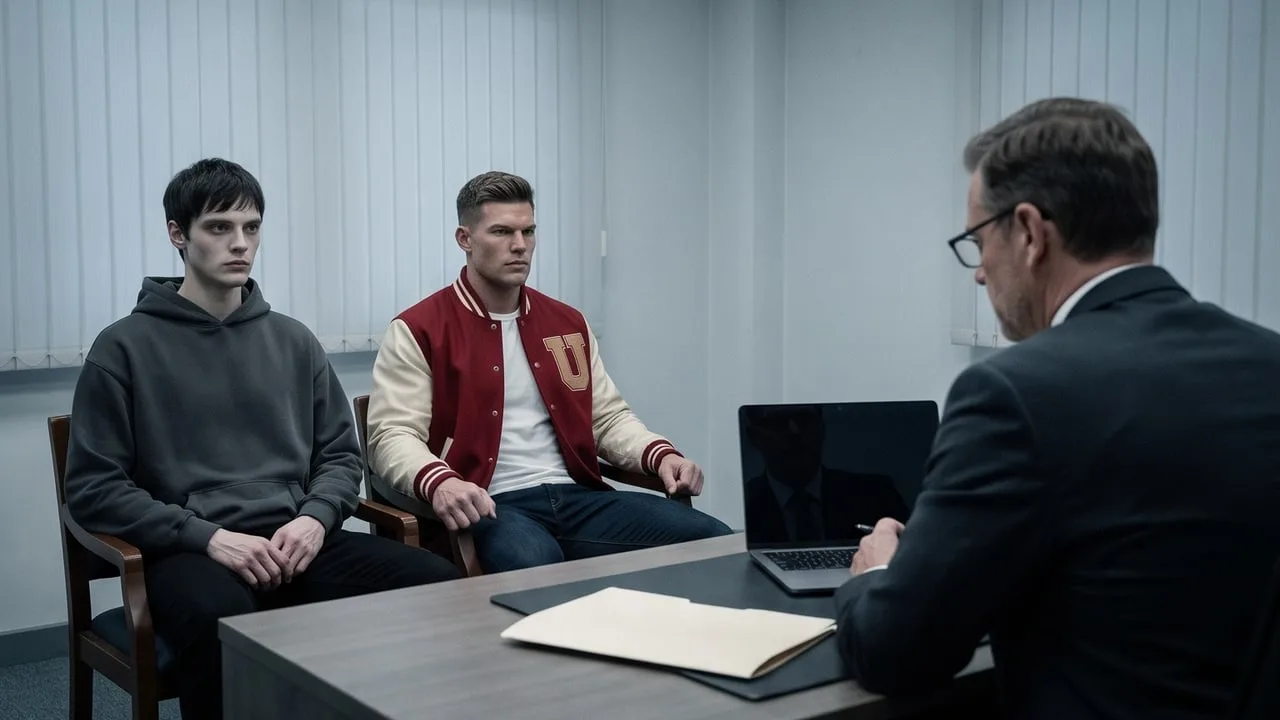
Jacob-the-master he had learned by heart over the years, down to the last line: the lazy set of the shoulders, the bored chin, the hands that always had room to spare. The Jacob sitting now in the next chair he was seeing in the flesh for the first time — and he couldn't look his fill. The jaw clenched so hard the muscles worked beneath the skin. The fingers gripping the armrest to white knuckles. A leg twitched, about to beat out a rhythm — and he pressed the foot to the floor himself. The big, strong body, always so free, sat as if in an electric chair, waiting for the current to be switched on.
And the switch was in his hand — Simon's.
The sensation was thick, dark, almost physical — .
— How are you feeling, Mr. Thorn? — the director began from a distance, lacing his hands on the desk. — How are your studies — keeping up?
— Everything's fine. Thank you.
— Good. Good… — He drummed his fingers on the folder. — Do you understand why I've called you in?
— I can guess.
— Then I'll explain how this will work. — The director spoke in a measured, official way, clearly from a prepared script: — The administration has received information. Serious information. By the rules, conversations like this are held with each side separately and on the record. But before setting the official procedure in motion — a committee, interviews, documents — I want, just once, to hear the two of you here, without papers. — He shifted his gaze from one to the other. — Mr. Voss is already acquainted with the substance of the complaints. Now I need to hear you, Mr. Thorn. And I want you to understand: whatever you say now, nothing will happen to you. Not here, and not afterward. That I guarantee you personally.
Simon nearly smiled. The tired grey man behind the desk was guaranteeing safety to the one person in the room who had no need of it.
— If it would put you more at ease, — the director added, after a pause, — Mr. Voss can wait outside.
The chair beside him creaked: Jacob tensed harder still, though it had seemed there was nowhere further to go.
— No need, — said Simon. — I have nothing to hide from Jacob.
The director blinked, but nodded.
— Very well. Then directly. — He opened the folder, checked it. — Mr. Thorn. The administration has received information that Mr. Voss has, over a long period, systematically abused you. Dates. Witnesses. Circumstances. — He raised his eyes. — Can you confirm this?
There it was.
Jacob stopped breathing. His whole morning's logic — the boy can't talk, his truth will drag his own along with it — had been built on the old Simon. And half a meter away sat a different one: dry, unreadable. And this different one now held everything in his hands — the field, the armband, the surname, his father.
Simon was in no hurry.
He rolled it on his tongue for a second, like a hard candy. One short word — "yes" — and he could watch it all collapse: the career, the status, the whole golden life. The temptation was honest, alive; it tickled his throat. But "yes" meant committees, papers, expulsion — and a Jacob who packs his things and leaves his life forever. "Yes" handed Jacob to the system.
— There's been a mistake, — Simon said, level and clear — the way he'd rehearsed it in the night, in the dark of his room, in a whisper, dozens of times. — Jacob has never raised a hand to me.
The chair beside him creaked again — sharply. Simon didn't turn his head, but he heard Jacob's breath break. Now it felt truly good.
The director slowly took off his glasses.
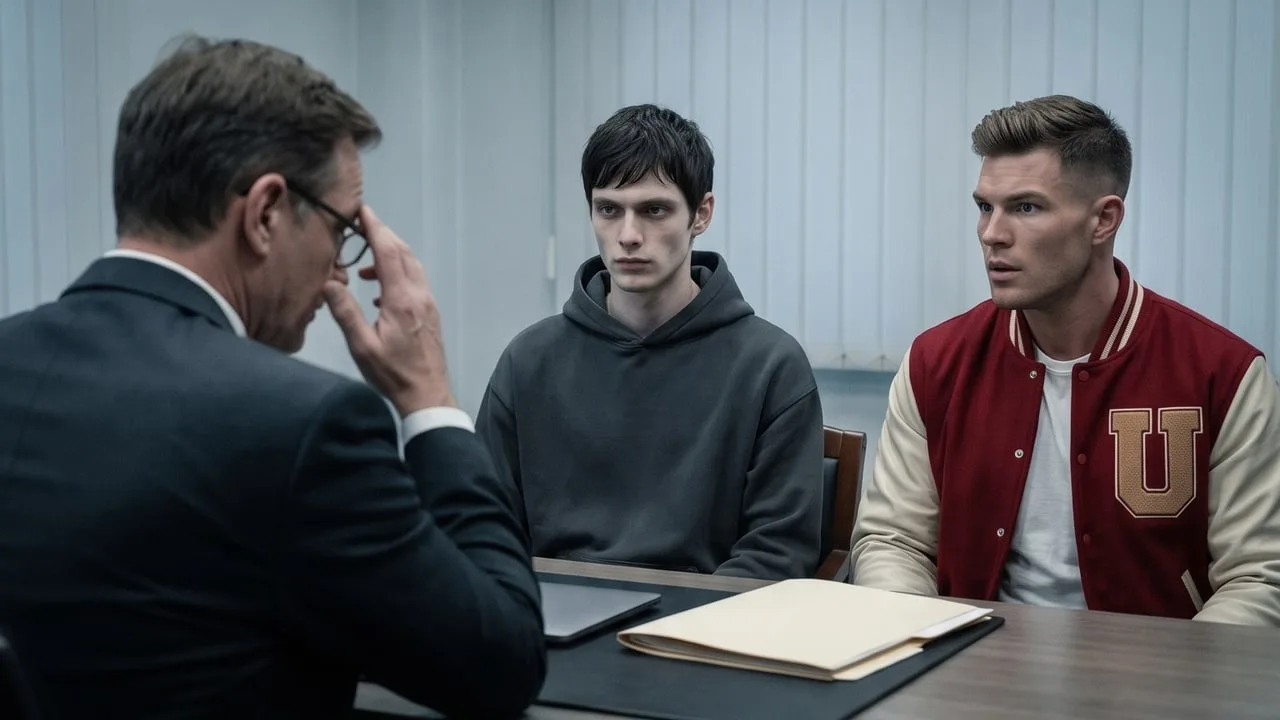
— Mr. Thorn. — His voice had gone hoarse. — Are you certain of what you're saying? I have grounds to believe otherwise. There is testimony. A great deal of testimony.
— People often see what they want to see.
— And the footage from the cafeteria? I've watched it, Mr. Thorn. It's hard to call that a friendly joke.
— But that's what it was. — Simon gave a slight shrug. — A stupid one. We take it too far sometimes. I'm not offended.
— Do you understand that if you're covering for someone right now, — the director chose his words carefully, — it will be far harder to help you later?
Simon turned his head and looked at Jacob — straight on, a little longer than propriety allows. Jacob held that look with difficulty: there was nothing in it of what he knew how to read.
— I don't need help, — Simon said, turning back to the desk. — We're friends.
The word landed on the director's desk . All three of them saw that it was counterfeit. And all three watched the director pick it up — and slip it into his pocket.
Because the director had been waiting for that word. The tension drained from the grey face so fast that it became clear: the man behind the desk had been praying for this "mistake" since the day before. Scandal, inspections, trustees — all of it crumbled into harmless dust, and digging down to the truth would have meant gathering it all back together with his own hands. He didn't. The director glanced sidelong at the closed laptop — in there, inside, lay forty seconds of truth — and did not open it.
— Well then. — He straightened, and his voice filled with an official sternness that no longer cost anything. — I'm glad the misunderstanding has been cleared up. But hear me, both of you: from this day on, the administration will watch everything that happens on campus with the utmost attention. The utmost. Attention. Mr. Voss — this concerns you first and foremost. You're dismissed.
The formal danger had passed.
But walking out of the office, Jacob felt nothing resembling rescue. He had just been pulled out from under expulsion — and it hadn't been done by his father, or his name, or lawyers. It had been done by Simon. The quiet grey boy had lied for him to the director's face — smoothly, publicly, flawlessly — and . In debt. To him. Everyone owed him, always; debts running the other way were something he'd never had — until this minute.
And above all, he didn't understand why. And that burned worse than the debt.
Simon left the reception room first and walked down the corridor — unhurried, not looking back, like a man who knows for certain he'll be followed.
Jacob came after, a dozen steps behind, and the questions shoved at each other in his head, treading on one another's throats: why had he lied? what did he want? what next? There was no answer to any of them.
Simon turned into an empty lecture hall. Without looking back. He simply opened the door and went in — the way you go into your own place.
The lecture hall stood echoing and half-dark: rows of empty seats climbed upward, a grey murk hung in the tall windows, dust drifted in the rare columns of light.
Jacob burst in after him three seconds later.
The boy hadn't hidden. Hadn't cowered behind a far row, hadn't gone to stand by the window — he stood in the middle of the aisle, facing the doors, and waited. It cut — for half a second, in passing — and drowned in the surging fury.
Jacob rushed him and grabbed him by the front of his hoodie.
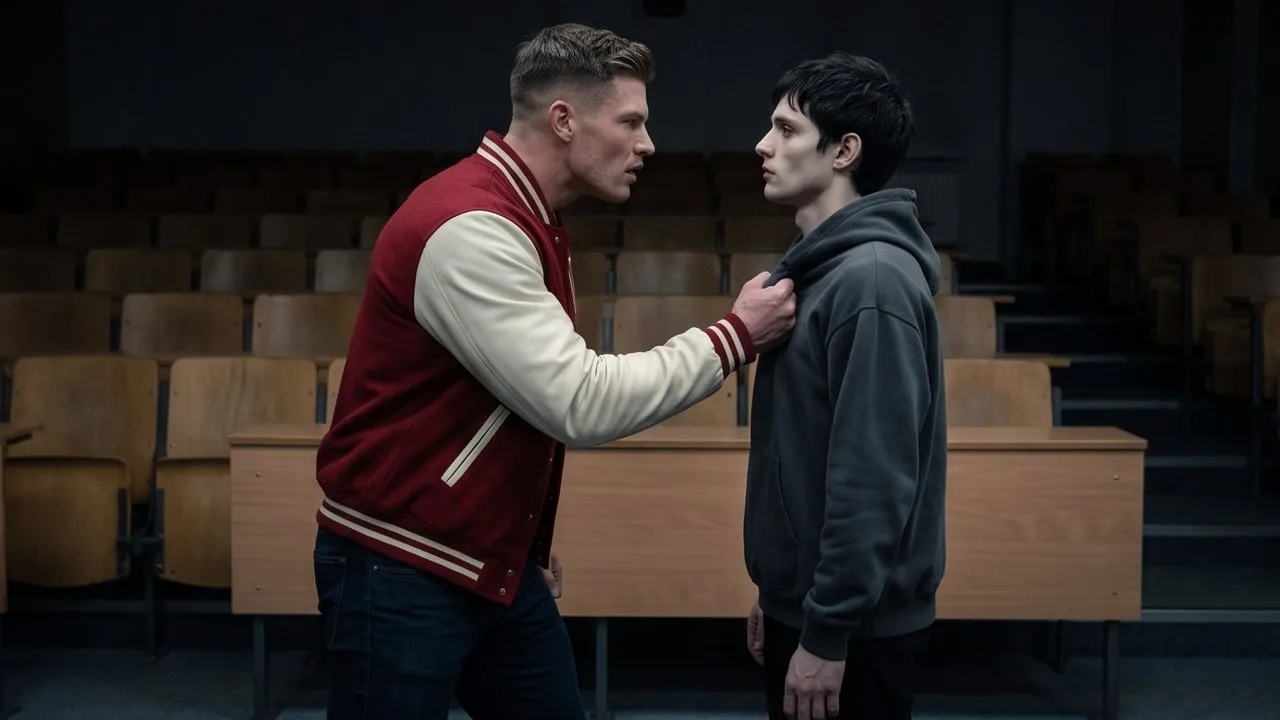
The movement was familiar, worn to automatic — and familiar was the pleasure it promised. He knew that body in his grip by heart. Knew how the thin shoulders turn to stone under the grey fabric. How the trembling begins — small at first, in the chest, right under his fist, then through the whole body, down to chattering teeth. He loved that trembling. For years, without admitting it to himself, he had come precisely for it: for the way another body surrenders in his hands — warm, submissive, shaking — and for the way a heavy, thick heat then spreads through his own veins. It was his trembling. His property.
He slammed Simon into the nearest desk — the wood boomed as it scraped across the floor — clenched the fabric till his fingers cracked, and with his whole gut, out of habit, braced to receive what was his.
There was no trembling.
The body under his fist stood quiet, the way furniture stands. The breathing didn't falter. The shoulders didn't turn to stone — it was all the same to them. Jacob held the same hoodie, the same boy, in his hand — and got nothing back, the way a hand closing on water gets nothing. And — filthiest of all — somewhere beneath the anger a dull, impossible sense of lack began to scratch: his body missed the other's trembling. Jacob trampled it before it could take shape, and broke into a shout:
— What the hell, Simon?! "Friends"?! You could've turned me in — just now, in there! One word — and I'm finished! What the fuck are you playing at?! You decided to blackmail me with the fact that they can throw me out now?!
Silence.
— Was this Ashley's idea? — He shook him. — Did the two of you cook this up together?
— Ashley has nothing to do with it, — said Simon.
— Then what do you want?! — Jacob ran through it aloud, faster and faster: — Money? You want me to back off? A public apology? Say something, at least!
Simon was silent and watched. Not one of the named prices stirred so much as a shadow in the pale eyes.
— I just want to talk, — he said. Cold and level.
— Talk?! — Jacob choked. — What the fuck do we have to talk about?!
— Everything. From the very beginning.
— Then let's! We'll settle this right here and right now!
— Not here. — Simon said it quietly, gently even, but under the gentleness lay something implacable. The boy wasn't arguing. The boy was setting terms. — We can talk in private. Calmly. — A pause. His gaze didn't let go of him. — At my place?
At his place. Jacob vaguely knew even the street — somewhere past campus, one of the ones you don't drive into. In all these years it had never once occurred to him that Simon had a home: an address, a door, a table, a bed. Things don't have addresses. And this one — was inviting him over.
He looked at the guy in front of him and didn't recognize him. He should have told him to go to hell, turned around and left — forced everything back into its familiar banks, the way he always did. But tell him off — and then what? The boy who had held him over the abyss today with a single word could, with that same word, unclench his fingers. The director is watching. Ashley is digging.
And anyway, what was there to be afraid of, when it came down to it? One on one he had always handled that body with one hand. Close your fingers on the throat — and the boy goes limp and falls silent, the way he always had. In private the advantage was his — wholly, familiarly, no two ways about it.
And there was one more thing — quiet, at the very bottom, the thing Jacob neither named nor examined. In private. With Simon. No witnesses, no directors, no phones. The thought slipped through — and he shoved it into the same place he shoved everything of that kind, and over the top, like a lid, he clapped down the convenient one: he's just going to go sort out a problem.
— Fine, — said Jacob.
One word. Hoarse, forced out, foreign.
He let go of the grey fabric, drew back — too sharply, the way you snatch a hand from something hot — and walked to the exit, feeling his gaze on his back all the way to the door.
And Simon stayed standing by the desk and watched him go.
And as the broad back receded toward the doors, a smile bloomed slowly across his pale face, like a crack across glass — triumphant, quiet, soul-chilling. In his head, drowning out the footsteps, the heavy iron chains rang again — very close now, almost real now.
The trap had snapped shut. The web was spun.
The prey had agreed, of its own will, to enter his lair.
He stood alone, and the empty hall looked at him with all its rows — in silence, the way they look just before the start.
The screen goes dark.
Continued in the next episode.