By morning the downpour had spent itself. The campus stood washed and hushed, the grey sky floating in the puddles, and Jacob walked across the yard by his usual route — through his usual world, in which everything worked as it should: the crowd parted, someone reached out a hand in greeting, the girls by the entrance to the main building lowered their voices after him out of habit.
The last few days had even been rather good. The world, which had lurched after the locker room, had settled back into place, and Jacob had nearly convinced himself that everything was under control again. Nearly. Simon he hadn't touched — deliberately, with the lazy pleasure of restraint: let him stew. There was nowhere to hurry. The secret lay inside him like a warm coin, and sometimes, in the middle of a lecture or a practice, Jacob caught himself touching it — just to check it was still there. It was. It wasn't going anywhere. No more than the boy himself.
The usual order of things broke down at the doors of the gym.
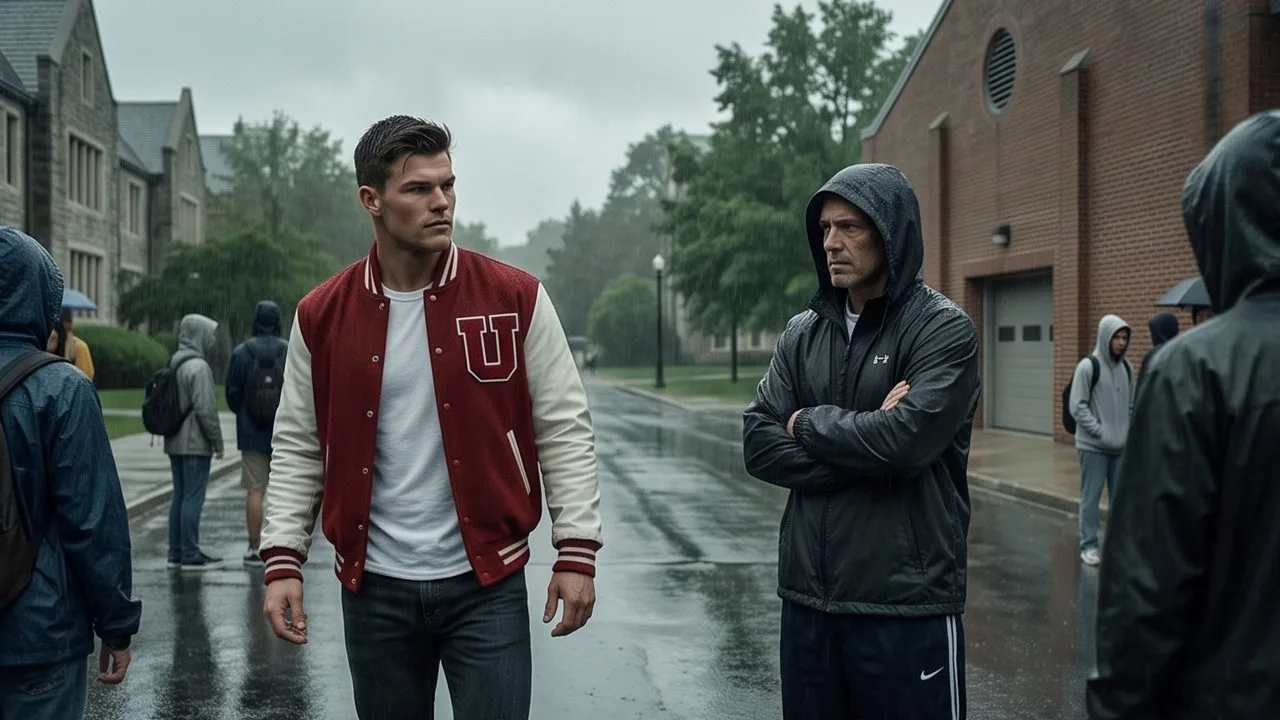
— Jacob. — The coach didn't call out to him — he blocked his way, planting himself across it. — The director wants you. Now.
— I'll come by after practice.
— Now, — the coach repeated.
And didn't look him in the eye.
Now, that was new. Jacob turned and headed for the main building, feeling an unaccustomed, stupid itch between his shoulder blades. He had never been summoned anywhere. Not once in all his years here — nor anywhere else, come to think of it. He was used to setting the rules, not obeying them; in this university even the practice schedule shifted to suit him. Trouble, in his world, happened to other people. : his father's plant, the jobs, the sponsor's checks at every anniversary — and anything that might have reached him always dissolved somewhere on the far approaches, quietly and of its own accord.
Judging by the coach's face, this time something had gotten through.
The corridor of the main building went on with its ordinary life: someone nodded, someone clapped him on the shoulder in passing, girls were laughing by the window. Jacob walked through all of it at his usual pace, sizing up what the director might want. Training camp? A sponsor's evening? Some professor's complaint about missed classes? None of it warranted a "now" and the coach's eyes looking past him — but he didn't bother thinking it through. He'd sort it out on the spot. One way or another, conversations with the higher-ups always ended the same way for him: with a handshake.
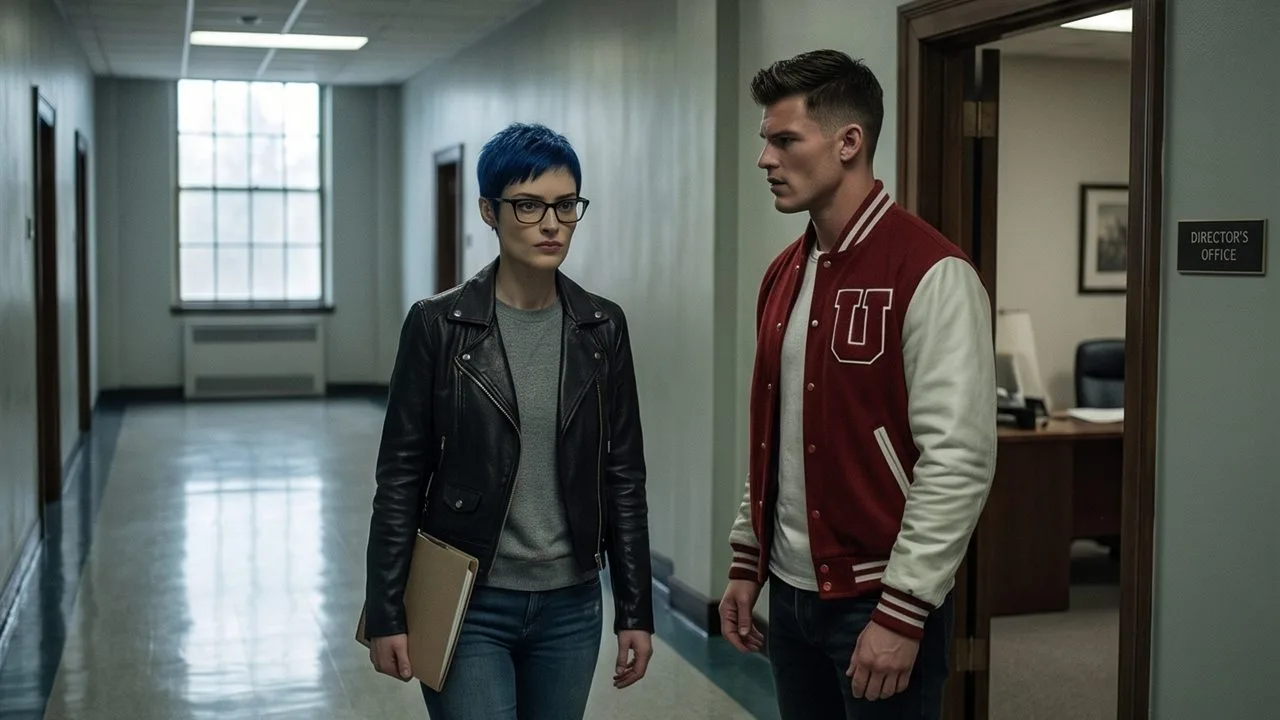
In the reception room the director's door opened toward him — and out of the office came Ashley Cooper. Blue hair, glasses, a folder under her arm. They crossed paths rarely, but they said hello — everyone said hello to him.
— Hey, — Jacob tossed out on autopilot.
Ashley raised her eyes to him. Looked — straight, calm, for a second — and walked past. Didn't turn away, didn't snort, didn't pretend not to notice. Just looked — and . No one had ever treated him like that, and for a couple of seconds Jacob stood watching her go, with a stupid "hey" left hanging in the air.
The secretary nodded him toward the door without lifting her head from her papers.
Before the heavy door with its nameplate, Jacob caught himself hesitating. On the other side he was not being awaited for a handshake — his body understood that before his head did.
He pushed the door open.
The director sat at his desk — grey, composed, too neat: a squared-off stack of papers, the phone face-down, the folder exactly centered. He did not offer his hand. He didn't rise, didn't even put on the routine cordiality — only held the folder by one corner with two fingers, the way you hold something that might crawl away, and looked somewhere at Jacob's chin. Jacob still didn't understand what all this meant. He simply noted it — the way you note a change in the weather: the office was cold today. And the master of this office seemed more ill at ease here than his guest.
— Have a seat, Mr. Voss.
No one had ever said "have a seat" to him in that tone — the tone that puts you in your place. Jacob lowered himself into the leather visitor's chair, spreading his shoulders out of habit — and they suddenly seemed superfluous: the chair was built for people smaller and quieter than him.
— The administration has received reports, — the director opened the folder without looking at him, — of systematic abuse of a university student. Dates. Circumstances. Witnesses.
He began to read aloud — dry, clerical, point by point. September: west-wing corridor, a shove, the victim struck the lockers; two witnesses. October: the stairs of the sports building, a tripped foot, a fall. October, again: property damage — the victim's textbooks in a trash can. November: west wing, twice in one week, shoves and public insults; recorded. And as a finale — the cafeteria: an incident with a beverage, video attached. The list went on, level and monotonous, like an inventory of property. Jacob listened, and the words from this alien paper world — "systematic," "recorded," "injured party" — strangely, wildly refused to fit the thing they named. What had been between him and Simon had no words at all. And certainly not these.
He mechanically scanned what he'd heard once more — and with cold relief noted the main thing: it was all only the public part. The shoves, the stairs, the cafeteria — everything you can see from the outside, from the crowd, from someone else's phone. About the dark part — the real part, the thing that happened behind closed doors — there wasn't a single line in the folder. Which meant someone on the outside had written it. And which meant the boy himself was still silent — even now, even here. Jacob knew why, and that knowledge made things not easier but murkier: the heart of it was about the two of them. Tell about the darkness — and you'd have to tell about what you yourself did in that darkness. About the locker room. About what he'd leaned in to reach with his lips. They were bound — tight, and as filthily as it gets: .
— This is a misunderstanding, — Jacob switched on the smile — warm, faintly guilty, honed over years: the smile that opened any door in this building. — We mess around sometimes, take it too far, it happens. Sport, adrenaline. It's just how it works with us, we're all —
The smile struck the director's face and crumbled without leaving a trace.
— Who filed this? — Jacob changed his tone. — The reports. Who?
— That's not relevant.
He answered quickly — too quickly, into the folder, without raising his eyes. And it was there that Jacob finally made out what had eluded him from the threshold: this man was frightened. Not of him — fear of himself Jacob knew by sight, and it looked different. The director spoke , to whom he was answerable — and it was for that person that he was performing.
It is relevant, thought Jacob. Very much so. His mind began to work, fast and cold.
Simon? No. Out of the question. The boy had kept silent for years — silent under the blows, silent under the soda, silent even then, in the locker room, when the coach asked him point-blank — and nodded: everything's fine. And above all, he couldn't talk: his truth would drag his own along with it, the one from the locker room. He wouldn't have come here. Not for anything.
But as for who would have — Jacob understood in the same second, and his memory obligingly tossed up a picture from two minutes ago: blue hair, a straight gaze right through him, a folder under her arm — and the director's door closing behind her. Cooper. Student council, the paper, her famous lists. Dates, witnesses, a timeline — that was her hand, her work: noticing. The conclusion settled inside him evenly and heavily, like a slab.
So that was who'd been digging under him. Not the victim. The protector.
The director silently turned the laptop toward him and pressed the space bar.
For forty seconds Jacob watched himself. Here he comes up to the corner table with a bottle in his hand. Here he tilts it — offhand, in passing, half-turned to the room so it can be seen. Here he drops the napkin onto a wet crown of hair. Laughter off-frame — thick, happy, many-voiced. The camera shakes with other people's laughter. He caught himself searching the frame for the second participant — and didn't find him at once: the wet grey figure sat in the corner of the screen motionless, like an object. The camera wasn't about him. What they were filming was Jacob: his entrance, his gesture, his napkin. Even his downfall they were filming as his show.
Fury rose in him instantly — but not at the man in the frame. At the ones filming. A forest of raised phones, obliging camera angles, "send it to me." Which of them? How many of them had there even been? Out of habit he turned his fire onto others — and for one second, exactly one, he did after all see the man in the frame through someone else's eyes: big, bored, tilting a bottle over a motionless grey figure as calmly as if watering a flower. Jacob .
— If what's described is confirmed, — the director closed the laptop, — the matter will be one of expulsion. At the very least, expulsion.
Expulsion. The word came in without knocking and began to spread. The field. The captain's armband. The team, the season, the scouts who came to watch him — the whole built edifice of his life, floor by floor. And his father. The thought of his father pricked deeper than the rest, brief and cold, like a needle: he drove it off without examining it.
— Who's going to confirm it? — Jacob leaned forward. He kept his voice level, and that cost him more than the whole of this day. — Reports, papers. Those are words. Who?
— The injured party, — said the director. — He's been invited. To confirm or refute — in person. In front of you.
And, as if on cue, the heavy oak door of the office slowly opened.
Jacob turned — and didn't recognize him at once.
On the threshold stood Simon. The same and not the same: an oversized dark hoodie, a deathly pale face, deep shadows under the eyes — the ghost of the boy he'd been pressing into the lockers only days ago. But the gaze had changed beyond recognition. The gaze was empty, level, and frighteningly calm. Jacob had braced to see anyone at all — tear-stained, vengeful, trembling, triumphant; any of the Simons he knew by heart, the way you know a thing of your own. This one he didn't know. He had, after all, read that body without words for years: how the shoulders bend, how the eyes hide, how the fingers whiten on a notebook pressed to the chest. Now not one of the signals was working. The back straight. The hands hanging loose. The gaze — into his gaze, not at the floor. The body that had answered him for years with the same thing over and over .
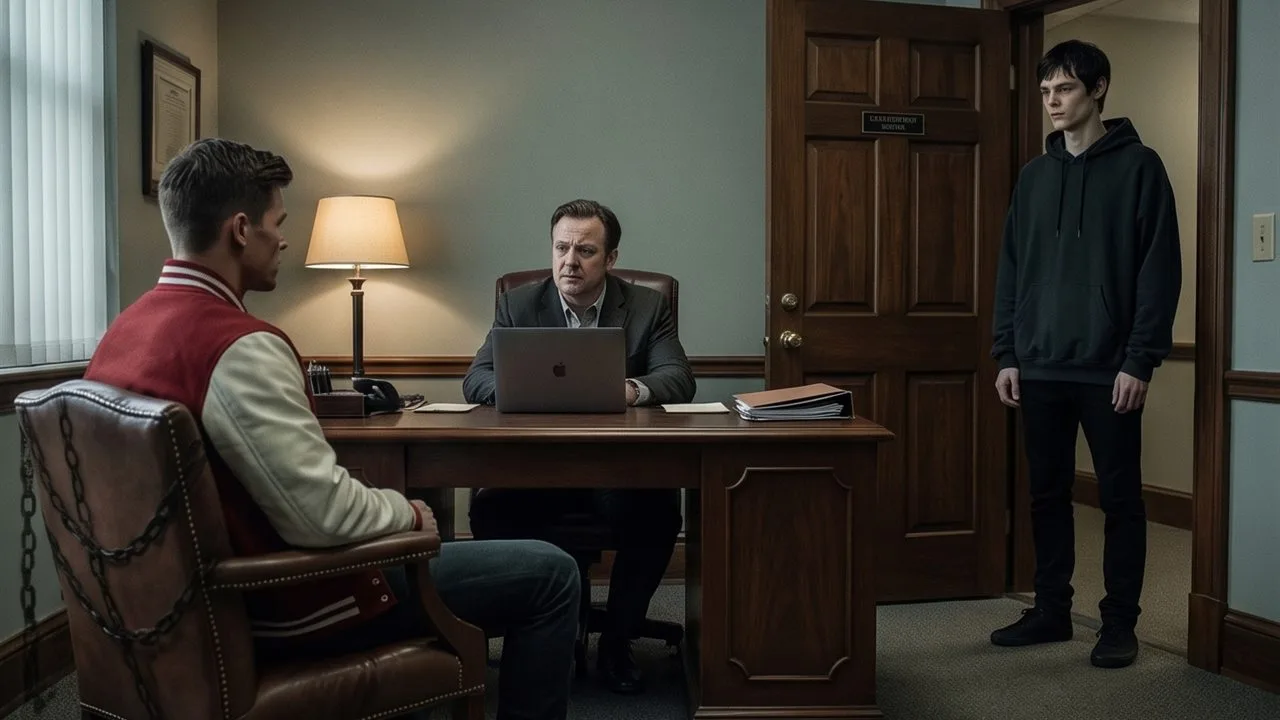
— Hey, Simon, — he said, dragging up the old condescending ease, and heard for himself how falsely it clinked. The smile came out nervous, alien.
— Hello, Jacob, — Simon answered quietly.
And smiled back — slowly, with just the corners of his mouth. The unnatural, quiet smile of a person who has already crossed his own line — and settled in there, on the far side of it. That smile sent a cold crawling down Jacob's spine — slow, real, having nothing to do with drafts: he was looking at a creature he had assembled himself, over years, blow by blow — and didn't recognize the assembly.
And Simon stood on the threshold and looked at the scene laid out before him the way you look at the model of your own dream.
There was the director — grey, frightened, with his folder: he thinks that here, at this desk, Jacob's fate is being decided. There, somewhere beyond the walls, was Ashley with her lists: she thinks she's the one who set that fate in motion. Let them think it. Jacob's fate, in this building, was known to one single person — and he was standing now in the doorway. That fate had nothing whatsoever to do with expulsion.
Here he had come calmly — well-slept, composed, ironed smooth from the inside. He'd reread the invitation twice that morning, the way you reread a program. They all thought they were summoning him to a trial — but he was going to a rehearsal. The real stage waited elsewhere, and its set stood before his eyes every night.
There was Jacob — in the leather chair across from the desk. Broad shoulders, the familiar set of them — but the way he sat was foreign: he sat as he had never sat in Simon's presence. On the edge. Not sprawling. The way you sit on someone else's territory.
And over this picture, seamlessly, like a double exposure, another settled. So easily that for a second Simon . And he understood that he didn't care.
Before, the frame had come to him in pieces: a dull gleam, links drawn upward, shackled hands. This night — and now, awake — the picture had at last assembled whole, down to the walls, down to the smell. The same chair. The same shoulders. Only the room around it darker and more muffled, and Jacob in the chair half-naked, his mighty arms drawn to the armrests by thick links of chain — fast, to white knuckles, to full and final immobility. The metal gleams dully in the dark. The room is very quiet — so quiet that two breaths can be heard: one ragged, hunted, and the other even, unhurried. His. The body that had spent its whole life breaking others cannot move a finger. And over it, in the shadow the light doesn't reach, he himself stands in silence. The master of this darkness. The master of these chains. The master.
The roles had switched. Jacob belonged to him alone.
The frame held a long time — longer than ever before — and Simon had to make an effort to return to the office, where it smelled of paper and someone else's fear and where the real Jacob looked at him from his chair, uncomprehending and lost — without a single familiar color in his gaze.
— Come in, Mr. Thorn, — said the director, and something almost like pleading showed through his voice. — Sit down. We need to hear the truth.
The truth.
What a convenient word. Everyone in this room had a truth of his own — and his own would not have fit into any report.
Simon stepped over the threshold.
The screen goes dark.
Continued in the next episode.