The forest reached them before it came into view.
First the streetlights disappeared. Then the houses. The last gas station fell behind them, a yellow rectangle of light, and the road narrowed into two wet, gleaming strips pressed between black walls of pine. The headlights tore white marker posts, slick bark, and the occasional road sign out of the darkness. Each appeared for a second in front of the car, then dropped instantly back into the void, as though the road behind them no longer existed.
Jacob took his hand off the gearshift and tightened his grip on the wheel.
— You said it was close.
— We're almost there, — Simon replied.
He did not look at the navigation. His phone lay facedown on his knee, black and useless. At every junction, Simon gave the direction before they reached it: right in two hundred yards; left after the bridge; there would be an abandoned bus stop farther on, then the turnoff. His voice remained even, without pauses, as if the route had been recorded not in his memory but somewhere deeper — in his body.
Jacob noticed it at the second turn. By the fourth, he had started counting.
— You come out here often?
— I used to.
— With your dad and his buddies?
Simon turned his head slightly toward the window.
— Sometimes.
It was not entirely a lie.
His father had brought him here several times when Simon was a child. The men took over the living room, opened bottles, shouted at the television, and laughed so loudly the house seemed to belong to their voices. Simon was sent upstairs so he would not get in the way. He lay beneath a heavy blanket in the cold bedroom and listened to other people's lives crashing below him. It was here that he first learned one useful thing: . People could scream behind the walls, curse, smash glass — the house would remain a dark stain between the trees. No neighbors. No accidental passersby. No one to knock and ask whether everything was all right.
As a child, that knowledge had frightened him.
Now it comforted him.
Simon rested his palm on the duffel bag between his feet. Beneath the fabric were blankets, bottles, and a bag of food. Lower still lay the cold weight for which he had chosen this house. The metal did not rattle. He had wrapped every link in cloth, secured the fastenings, and checked the zipper twice. Everything was in its place.
Including Jacob.
He sat beside him — real, warm, alive. Not a fantasy behind closed eyelids, not a reflection in a mirror, not a silhouette at the end of a corridor. Simon could reach out and touch his shoulder. He could lay his hand on the broad forearm moving with the wheel. He could say, Stop. Let's go back. Forget it.
The possibility still existed. He could feel it clearly — .
That was exactly why he refused to look at it.
Too late. Not after the cafeteria. Not after the locker-room tiles and another man's disgust only inches from his face. Not after three years in which Jacob had taught him to confuse fear with desire, pain with attention, humiliation with the only form of intimacy available to him.
Simon did not intend to hurt him. He repeated it every time he checked the chains, the fastenings, the locks.
Not pain.
Only stillness. Only the inability to leave. A few hours of absolute honesty Jacob would never give him willingly.
He would make him listen.
And then everything would finally become simple.
Jacob had an excellent sense of distance.
On the field, it worked before thought. His body knew where the hit would come from before the other player shifted his weight. It noticed a break in the defense, a shoulder out of position, the wrong angle. That was why the coach valued him. Jacob did not analyze danger — he felt it on his skin.
Now that same instinct was scratching quietly and persistently from inside.
Nothing concrete was happening. Simon sat calmly. The road was an ordinary country road. The bag held beer, food, and blankets. Ahead waited an empty house where they would finally deal with the mess that had grown between them over the past few days until it had become a separate life.
And still, something did not fit.
"Close" had turned into almost an hour on the road. Cell service had vanished ten minutes earlier — first one bar, then an empty icon. Oncoming cars had stopped appearing. Simon knew every turn, yet had said nothing about the house until Jacob asked. And his silence was not what it used to be.
Before, Simon's silence had been a contraction. It carried fear, the expectation of a blow, the effort to make himself smaller. This silence was different — open, spacious. Simon was not hiding inside it. It was as though he had let Jacob enter and was now waiting calmly for him to reach the middle on his own.
Jacob glanced at the passenger.
Simon looked straight ahead. The soft dashboard glow lay across his pale face, and there was something almost peaceful in it. Not happiness. More like the calm of someone who had already made a decision and no longer argued with anything.
Something tightened briefly and unpleasantly beneath Jacob's ribs.
— What exactly do you want to talk about? — he asked.
— Us.
One word.
Jacob smirked, but the expression came out dry.
— There's an "us" now?
Simon turned his head. In the dim interior, his eyes looked almost black.
— You're the one who made sure there was.
Jacob's hands tensed on the wheel. He could stop the car right now. Turn around. Leave Simon at the nearest gas station — if a nearest gas station even existed out here — and end the story in the usual way: with a threat, a blow, loud laughter in front of witnesses.
But the thought of turning around struck his pride.
Being afraid of Simon was absurd. This was the same Simon he had spent years pinning to walls with one hand. A skinny boy in a gray hoodie whose neck fit almost completely inside Jacob's palm. Whatever Simon had planned, Jacob was still stronger. Faster. He could always leave.
There was something else too, something far less convenient.
He truly wanted to hear what Simon would say about "them." He wanted to know what hid behind the new stare, behind the calm, behind the "we're friends" with which Simon had pulled him out of the director's office. His curiosity had stopped being simple a long time ago. It reached deeper, into the place where a dark, possessive warmth lived beside his irritation.
Jacob increased his speed.
— Then talk, — he said. — I'm listening.
— Not here.
— Of course. — He gave a short, humorless breath. — Your conversations require a house in the middle of the goddamn woods.
Simon smiled almost imperceptibly.
— No one will interrupt us there.
For the first time, Jacob's instinct did not merely scratch.
It struck.
Briefly. Coldly. Directly beneath his breastbone.
He looked at Simon again, but Simon had already turned toward the window. Pines streamed past the glass, continuous and identical. Their reflection laid Simon's face over the dark forest — pale, motionless, almost bodiless.
For one second, Jacob imagined the passenger seat beside him was empty while the reflection kept staring at him anyway.
He blinked.
Simon was still there.
— Take the next right, — he said quietly. — It turns into a gravel road. Don't miss it.
The first drops hit the windshield at the turnoff.
Sparse and heavy, each spread across the glass like a separate dark star. Then the rain thickened, and the wipers began moving faster, slicing through the water in even, nervous strokes. The asphalt ended. Gravel crackled beneath the tires.
The road sloped down between the trees. Branches closed over the car, scraping the roof and side windows with dry fingers. From time to time, the headlights dragged an old fence, an overgrown sign, or a collapsed stone post out of the darkness — remnants of some order abandoned long ago.
— Does anyone live out here at all? — Jacob asked.
— No.
The answer came too quickly.
— Convenient.
Simon turned toward him.
— Yes.
They did not speak again.
Jacob felt the premonition growing, gaining weight. It was no longer a thought. It had become the physical sensation of someone's eyes between his shoulder blades, though no one was in the car except Simon. He wanted to turn on music, fill the cabin with something human and ordinary. He pressed a button on the console.
The radio answered with static.
Not a single station.
Simon listened to the white noise for several seconds.
— There's no signal here.
— I figured that out.
Jacob switched it off more sharply than necessary.
Beyond the next bend, the forest suddenly opened.
The house did not emerge gradually. It appeared all at once, complete, inside the white cone of the headlights.
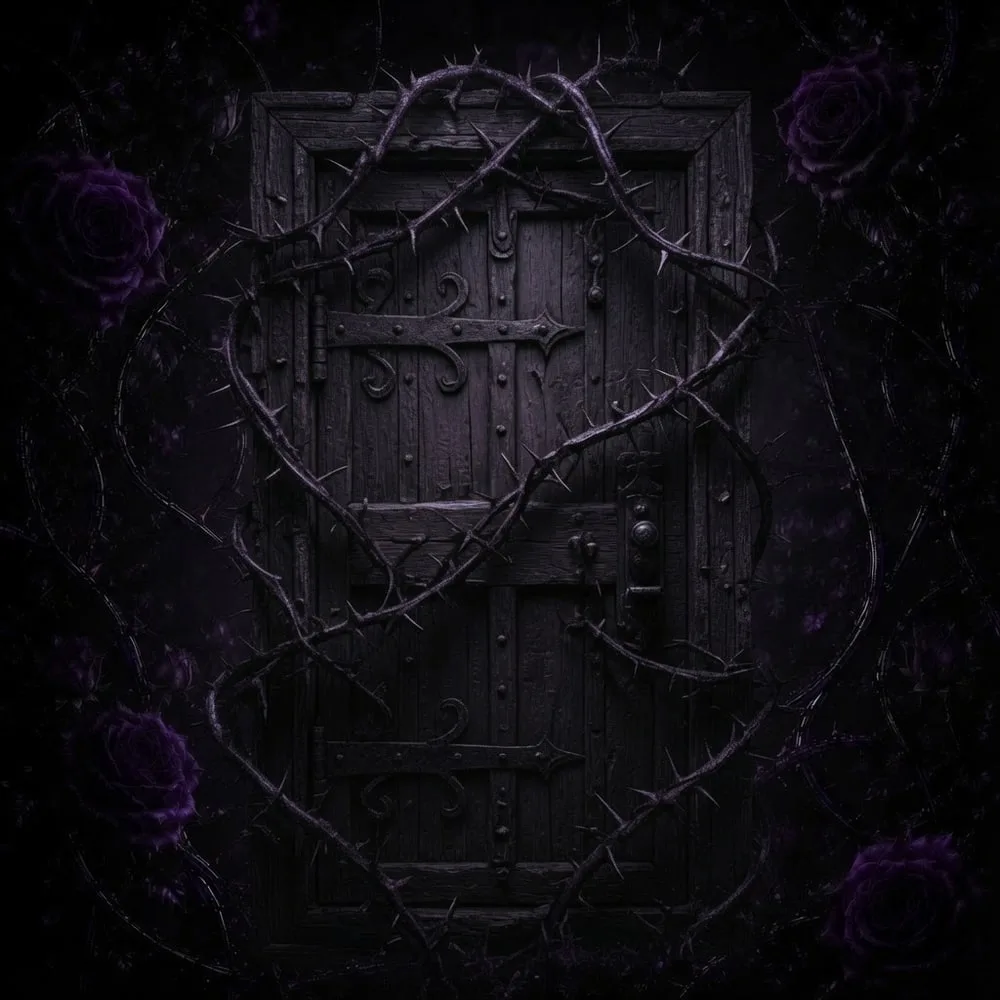
Two stories. Dark. Standing at the very edge of the trees. Thick ivy wrapped the walls and porch so densely it looked less like growth than something holding the building in place. Thorns darkened among the wet leaves. Here and there, impossible in the cold and gloom, purple roses showed through — heavy with rain, nearly black. Their petals shone like fresh wounds.
A weak, warm light burned in the windows.
Jacob slowed.
— You said no one was here.
— No one is.
— Then why are the lights on?
— I came earlier. Prepared the house.
That word again.
Prepared.
Not aired it out. Not cleaned up. Not turned on the heat.
Jacob stopped in front of the porch but left the engine running. The headlights lay across the door, the ivy, the wet steps. Rain hammered the roof. The engine vibrated steadily beneath their feet — alive, ready to carry them back at any second.
The time glowed on the dashboard. The city was nearly an hour away. No service. An empty house. Simon had come here in advance and prepared something.
A clear, simple command rose inside him.
Do not get out.
Jacob sat with one hand on the gearshift, staring at the door.
Simon did not hurry him. He did not ask why they were sitting there. He simply waited, and that quiet patience became the final push.
Jacob smirked and killed the engine.
— Creepy place, baby.
The word slipped out by itself, as it always did. But now it sounded different — not like a threat or a taunt. Almost like an attempt to restore the old order. To remind both of them who was supposed to be afraid.
Simon looked at him.
— You'll like it.
The seat belt clicked free.
By the time they ran to the porch, the rain had soaked their shoulders. Jacob reached the door first, shook water from the red-and-white sleeves of his jacket, and tugged impatiently at the handle.
Locked.
Simon stood one step below him, the duffel bag in his hand. Rain streamed from his hair and down his pale face, yet he seemed not to feel the cold. He took an old brass key from his pocket.
For a moment, he held it in front of the lock.
There it was — the boundary.
Until now, everything could still be called a drive, a strange meeting, a conversation. Once the key turned, what he had lived for during the past few days would begin. Jacob would enter of his own free will — .
The key slid into the lock.
The dry click sounded louder than the rain.
The door opened with resistance, its lower edge dragging across the floor. Jacob entered first — of course he did, confidently, without waiting to be invited. Simon stepped in behind him and closed the door.
Outside remained the rain, the forest, and the only road back.
Inside smelled of dry wood, dust, old fabric, and fire. A fireplace burned at the far end of the living room — not brightly, but steadily. Long oak logs Simon had arranged several hours earlier cracked and settled, throwing slow orange shadows across the walls. Dark vases stood on the shelves, filled with roses cut long ago. They had dried without losing their shape and now looked like small charred hearts.
Jacob looked around slowly.
The room was too prepared for an abandoned house. A blanket lay across the sofa. Two clean glasses stood on the low table even though the beer came in bottles. Near the fireplace waited a rough wooden chair, pulled away from the wall and turned directly toward the flames.
Jacob's gaze remained on it a second too long.
— Your old man really brings his friends here? — he asked. — Or do you people summon demons on weekends?
— They like the quiet, — Simon replied.
He removed his damp hoodie, hung it neatly on a hook, and walked toward the kitchen island. The duffel slipped from his shoulder and struck the wooden floor.
A dull metallic clang cut through the room.
Jacob turned.
— Jesus, man. What's in there, bricks?
Simon crouched beside the bag and calmly opened the zipper.
— Beer. Food. And my father's tools.
— In case the conversation goes badly?
It was a joke. Jacob even smiled. But his eyes stayed on the bag.
Simon lifted his head.
— In case something breaks.
For several seconds, they looked at each other.
Then Jacob snorted, turned away, and crossed to the fireplace. He could still feel the string inside him — taut and warning — but a house was only a house, Simon was only Simon, and the open top of the bag did indeed reveal brown bottles and the edge of a folded blanket.
Jacob dropped onto the sofa, spread his legs, and threw one arm across the backrest, returning his body to the familiar pose of a man who owned every space he entered.
— I hope the beer's at least cold, — he said. — This crypt is only good for hunting ghosts.
— Ice cold, — Simon answered. — The way you like it.
He took out two bottles. He placed one in front of himself. He held the other by the neck and turned toward the kitchen counter, blocking it with his back.
Every movement had already been rehearsed.
The cap came off quietly. From an inner pocket of the bag, Simon took a paper packet folded into quarters. He opened it above the bottle and poured a fine white powder inside.
No haste.
No trembling.
He slowly rotated the bottle in his hand, allowing the contents to dissolve into the dark liquid, and watched the last pale grains disappear without a trace.
Behind him, the sofa creaked.
— Simon.
His hand stopped.
— What?
— Come over here already. — Jacob sounded irritated, but beneath the irritation was something else — the exhaustion of fighting his own premonition. — Let's drink and finally talk.
Simon closed his eyes for the length of a single heartbeat.
Let's.
The most ordinary word.
He hid the paper, took both bottles, and returned to the living room.
The warm firelight settled across his face. This time, Jacob was not at the center of the flames.
Simon was.
Jacob sat a little farther back, inside a strip of shadow, looking up at him with an expression Simon had never seen in his eyes before: wary, almost attentive.
Simon held out the opened bottle.
Their fingers touched against the cold glass.
Jacob did not let go at once. For several seconds, he held the bottle with Simon and studied his face, as if, at the final moment, he was still trying to read the thing he had felt since the edge of the forest.
— You're acting fucking strange tonight, — he said quietly.
— Tonight, I'm being honest.
— We'll see about that.
Jacob took the bottle. He raised it to his lips without taking his eyes off Simon.
The voice inside him said it again.
Don't drink.
But .
He took the first swallow.
The screen cuts to black.
To be continued.