The locker opened with the same squeak as the day before yesterday.
Craig pulled his kit out of his bag and started changing. The locker room was loud: doors, steam, swearing, someone guffawing in the aisle. The guys clapped him on the shoulder — "look who's back," "bro, how you doing" — and he answered "fine." Nobody asked how it had happened. Here they didn't ask "how." Here they asked "who."
For three days he'd been waiting for a call from Jacob.
Not from the dean — from him. He'd hit when someone nodded; laughed when the others laughed; gone in first wherever it was beneath a captain to go. If anyone had asked, he'd have said he never thought about it like that. But there was a place inside him where he knew: if anything happened, Jake would pull him out. One word to his father. One call to the dean.
The phone had been silent for three days. He'd called himself — twice — and listened to it ring all the way out. Yesterday Becker had texted: Jake banned talking about you. Period. Anyone who wants to goes to him alone.
Nobody went. And Jake didn't come either.
It was a girl who'd pulled him out. With one call. Craig understood what that meant — as clearly as he understood the weight on a barbell: three years at Jacob's side had been worth exactly nothing.
You don't show hurt in a locker room. He shut his locker, sat down to lace his cleats, and listened to the door.
When it opened, his head came up on its own — to find a face, find a look, find a nod.
There was no nod. There was Jacob's face, seeing him.
Craig dropped his eyes to his laces. He remembered what he'd promised. And to whom.
He saw him from the door — the broad back, the nape, the familiar hunch over the cleats — and for a second stopped walking.
A second was enough. After that he walked the way he walked every morning, and his face was what a captain's face is supposed to be when a player comes back: blank.
"Jake!" Becker, from the other end. "You see? They brought Craig back! You must've..."
He didn't finish. They were looking at Jacob — waiting for a reaction. They thought it was him: "you could do something," "your dad — one word" — and look, Craig was back. He didn't set them straight. He opened his locker, tossed in his bag, pulled off his jacket.
He hadn't called the dean or his father. Any call would have meant taking Craig's side against the complaint Simon had filed — and he couldn't do that. Taking the other side — he couldn't do that either. So he'd done nothing and called it "not up for discussion." He'd watched Craig's two calls come in and hadn't picked up. The only decision he'd made all week without anyone prompting him: not to decide. And there it sat, three meters away, lacing its cleats.
He walked over — unhurried, the way you'd walk up to one of your own players — and stood with his back to the room, blocking Craig with his shoulder. The noise didn't drop: the captain talking to someone at a locker, nothing unusual.
"Who," Jacob said, barely moving his lips.
Craig pulled one lace tight. Then the other.
"Priscilla. She decided to help."
Jacob waited for more. There wasn't any. Craig straightened up, gave him a brief look — the way he used to look at him when waiting for instructions — and added nothing. No "don't know why," no smirk. Just the name.
"Pris," Jacob repeated.
"Her."
"Why would she?"
Craig shrugged — honestly: the shoulders of someone who doesn't know. Or who's pretending; right now Jacob couldn't tell the difference.
"Ask her. I was told: you're back tomorrow. So I'm back."
He stood up — two centimeters taller, noticeably heavier, and, as before, half a step behind. He took his mouthguard from the shelf and looked at Jacob, waiting to be told where to go.
"Out to the field."
"Got it."
Craig headed for the exit; the guys made way. He did as he was told. The team went quiet. The leash — the one Jacob had told Simon about at the window — was in his hand.
Only now he wasn't the only one holding it. The name turned out to be worse than "don't know": you can live with "don't know," but a name means you have to do something.
Pris, who in three years had never once asked the loosehead prop's name. Pris, who yesterday had stood in his kitchen with keys in her hand.
Practice went fine. He didn't remember a thing about it.
He found Priscilla after third period, outside a lecture hall, with two girls from her squad. The girls saw him and drifted away: whenever he came up to her, an empty space formed around her — as much a part of them as a couple as everything else.
"Craig's back," he said. "That was you."
Not a question. She didn't pretend — didn't raise an eyebrow, didn't ask "who?" She tilted her head slightly, the way you do when you're being complimented.
"It was."
"Why?"
"Sweetheart." She straightened the collar of his jacket: a gesture the corridor watched, because it was meant to be watched. "You have a game this weekend. Without Craig your scrum gets crushed — your whole team's saying it, I heard them at the coffee machines. If you lose — whose reputation is it? Yours. The captain who lost his loosehead over one complaint and didn't lift a finger." Almost tenderly: "I didn't want people saying that about you."
"You didn't ask me."
"You'd have said no. Out of pride. And then you'd have lost and been angry at everyone except yourself." She smiled. "For three years I've watched you keep this team in your hands. I didn't want it ending up in someone else's."
He said nothing. She was right in every word, and there was nothing to grab hold of: to say "you shouldn't have," he'd have to explain why, and explaining meant naming the person who had stood in his kitchen in his T-shirt.
"Is that all?"
"That's all." She took his arm — for three steps, as far as the corner, so the corridor would see a couple. "Now, the important thing. Saturday. The restaurant — they've closed the room for our families. Daddy and your father have agreed on something — we'll find out over dessert. Seven o'clock. You remember?"
"I remember."
"Tuxedo. Not a jacket. A tuxedo."
She let go of his arm and walked off — light, as if that kitchen, the keys on the counter, and his "you'd better go" had never happened. Not a word about the kitchen. He didn't say anything either. Yesterday he'd texted her "we'll talk when things settle" — and now things had settled on their own, in half a minute outside a lecture hall. He called it "not the right time."
The scrum, reputation, the team. So plausible there was nothing to object to. And yet she didn't spend her father's calls on things that didn't interest her — and Craig didn't interest her, any more than anyone else who stood behind Jacob.
So something else interested her. What, he didn't know. He knew one thing: Craig was here again, she was the one who'd brought him back, and the only person who had reason to be afraid now had nothing to do with the game or the scrum.
Simon had to be kept away from Craig. And for that — he had to know where Simon was.
He texted: Maple, at six.
The car was waiting at the corner of Maple with the engine off — black, low, not from around here.
He got in. The door shut with a soft, expensive sound. For half the drive they didn't speak; a question lay in the silence, and both of them knew which one. Simon held it until the campus was behind them.
"Was it you who got Craig back?"
"No."
Jacob didn't take his eyes off the road. His thumb drummed a short beat on the wheel and went still.
What Simon had pieced together that morning at his locker crumbled. It had rested on a single "if": if Craig was keeping quiet because he'd been told to. The "no" was short, without a hitch. Jacob would have lied differently — more quietly, more warmly, looking him in the eye.
"Then who?"
A pause. Three more taps on the wheel.
"Doesn't matter," Jacob told the road. "I'll deal with it."
Simon turned his head. He knew how Jacob sounded when he didn't know something: irritated, repeating the word twice. This sounded different. Jacob knew and wasn't telling him — it went into the same row where the phone call and the keys on the counter already lay.
He didn't ask a second time.
"Stay away from him," Jacob said. "Don't talk to him, don't go near him. If you see him in the hall, go the other way."
"That's all I've been doing for three years."
The car turned, and the houses got lower. By the corner store, men in work jackets followed the black car with their eyes.
"There's an apartment," Jacob said. The way you'd announce a schedule. "Near campus. New building, second floor, windows onto the courtyard. A doorman downstairs — nobody goes up unless he calls first. I looked into it."
"What?"
"You'll move." He nodded at the street beyond the glass. "Look at your house. The windows don't close. You get hit in the face there for coming home at nine. I'm not going to drive you there every night and wait for you to get upstairs."
Not once had this person talked to him about where he lived. Home had been the place Simon disappeared to after class. Now he was being offered a replacement.
"Why would I move?"
"Because."
"I can't pay rent." He said it calmly and only afterward heard how it sounded. "I don't have that kind of money. I don't have any money at all."
The car jerked — Jacob had slowed down too sharply.
"You think I'm asking you to pay?" He turned, and his face looked as if he'd been accused of something filthy. "You think I'm asking you for money?"
"I didn't..."
"I'll pay. All of it. Rent, furniture, whatever you need — we'll buy it." Fast, angry; the anger was real. "This isn't about money. I want you to be okay. I want you to stop going up to your room like it's somebody else's house. I want nobody walking in without calling first."
The shame came before Simon understood what it was about. Not the money — the fact that there wasn't any, and that it had suddenly become audible in the car, like a sound. He was sitting on a leather seat, in a hoodie he washed in the sink, and a person who had never had to count what anything cost was offering to buy him a place. Like the bike he hadn't taken. His hands on his knees looked empty.
And beneath the shame lay something else, colder. An apartment Jacob paid for was Jacob's apartment with Simon inside it. A doorman who wouldn't let anyone up without calling was a doorman who knew whether he was home. The house was his father's, the apartment would be someone else's, and between the two there'd be nothing left that was his.
"No."
"Simon."
"No. I'm not going to live on your money." And more quietly, because this was the main thing: "I don't want to be someone who's paid for."
The hands on the wheel went white. Jacob could drive and be angry at the same time, but the car grew cramped with everything he wasn't saying.
"They hit you there."
"Yes."
"And you're saying no."
"Yes."
Two blocks of silence. Simon braced himself — like in the kitchen. His shoulders had already risen, out of habit.
"Fine," Jacob said. Through his teeth. "No it is. Live in that, then."
And that was it. He didn't repeat himself, didn't push, didn't reach for him — he left the "no" lying where it had fallen.
He'd been heard. Angrily — but heard. After the kitchen, he'd thought that didn't happen anymore.
He leaned over and kissed Jacob on the cheek.
On his own. Quick, awkward, on the cheekbone — Jacob was driving and wasn't expecting it; the cheek was warm, stubbly, smelling of an unfamiliar gel. Simon pulled back before he'd realized what he'd done and turned to the window, his face burning.
Jacob breathed out through his nose — the way you breathe out when something has clicked into place.
His right hand left the gearshift and settled across Simon's shoulders. Drew him in — without a jerk — until Simon's shoulder rested against his side and his head found a place by Jacob's collarbone. He drove with his left. The street slid past the glass — fences, trash cans, other people's windows — and Simon sat pressed against someone else's side, listening to the heart beating under the jacket. It was simple. He couldn't remember the last time anything had been simple.
A minute, maybe a little more. At the turn Jacob needed both hands; he took his palm away — fingers trailing over Simon's neck, through his hair — and moved it back to the gearshift. Simon sat up straight. The warmth stayed.
"I won't be around tomorrow." A smirk, a joyless one. "Dinner. Both families, a restaurant, a private room. My father. Pris. A tux."
The warmth didn't leave — it suddenly ended up off to one side, like something set down in the wrong place. An apartment you could drive over to — and that nobody would come out of to meet you when a stranger's car was parked at the gate. And a restaurant with a private room, where you go in front of your fathers, in a tux, with her on your arm. Two rooms. One for Saturday. The other for everything else.
"Jacob," he said quietly. "What am I to you?"
Jacob was taking a turn: hand on the gearshift, head toward the mirror, the turn signal clicking louder than Simon's voice.
"What? Didn't catch that."
He really hadn't caught it. That was worse than if he'd been pretending.
"Nothing."
"What do you mean, nothing?"
"Nothing. Forget it."
Jacob glanced at him and went back to the road.
"I'll pick you up in the evenings," he said a minute later. "Every day. If you won't move — at least that."
Picking up means knowing where you are. Every day means always. He looked at the hand that a minute ago had been around his shoulders and remembered it yesterday — on the back of his head, fingers in his hair, not letting him turn away.
The car turned onto his street. Peeling facade, dark windows, trash cans by the stoop. His father's car wasn't there.
Jacob cut the engine.
"You've got your dinner tomorrow," Simon said.
"I'll come by after."
"Don't."
The fear only came afterward — and he turned to Jacob, because things like this you say to someone's face.
"Stay there as long as you need to. Nothing's going to happen to me. I want one evening just to be at home. Alone."
Jacob looked at him for a long time.
"I'm coming by anyway," he said. "After dinner."
Simon got out. The car stayed at the curb until the door had closed behind him.
His father wasn't home. Simon went up to his room without turning on the lights downstairs.
The room greeted him with what he'd left two days ago: the made bed, a textbook, a stack of notebooks, headphones coiled in a ring, the olive backpack on the chair. The only place in the house where things stayed where he'd put them.
He took out the notebook — its corner had gotten crumpled that morning at the locker — and slid it under the textbook to flatten it. He took off his hoodie, pulled Jacob's gray T-shirt over his head, folded it, and laid it on the backpack. Someone else's thing in the middle of his order. He didn't put it in the wash.
Nobody paid for this room. His cheeks were still burning — both of them.
He sat down at the desk, opened the textbook, and read a paragraph three times without understanding a word. He wasn't listening for the stairs — he was listening for an engine at the curb.
The phone stayed silent. He set it screen-up, put on his headphones, and sat like that until it was dark outside.
Saturday passed quietly. His father's car wasn't there on Saturday either; he slept until nine, washed his hoodie, went out for bread. By evening only one window in the house was lit — the kitchen's.
The restaurant downtown shone with a light closed to outsiders.
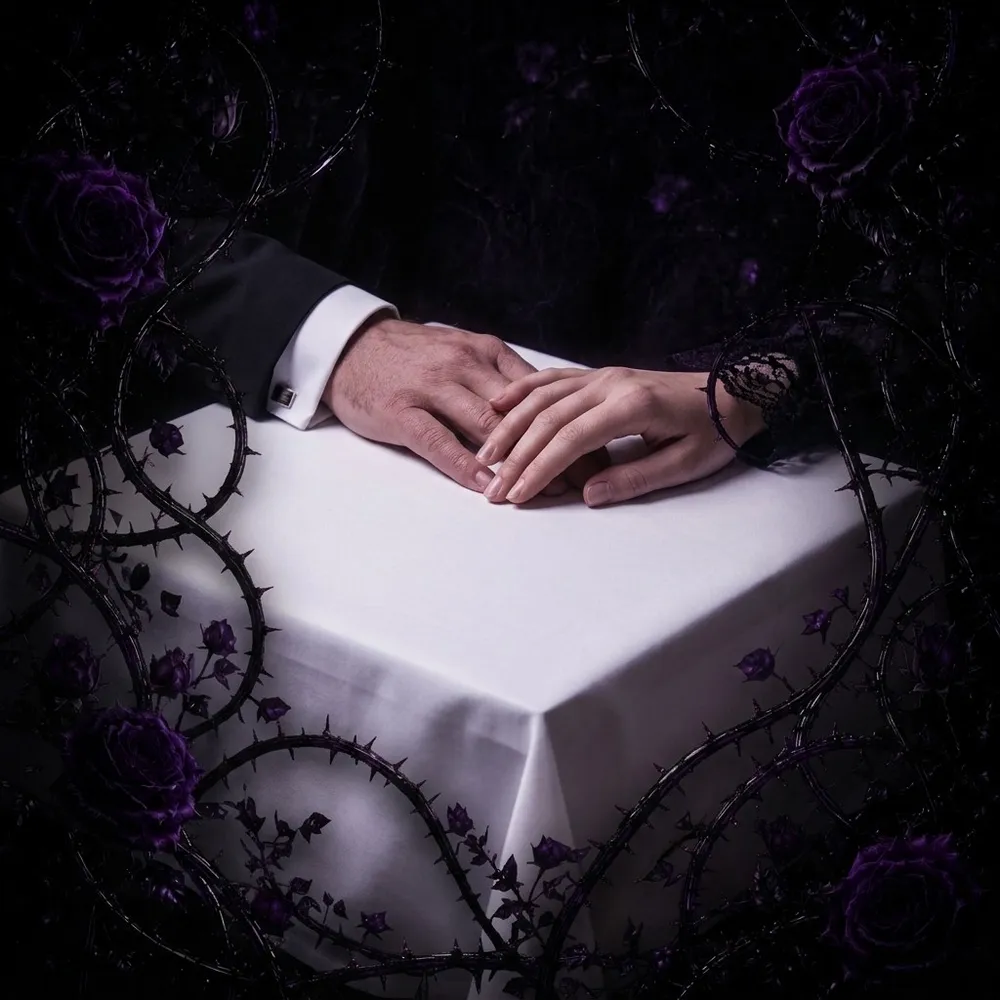
They'd booked the whole room: a long table under white tablecloths, crystal, waiters who appeared before they were needed. The two families on either side, seating by place cards. Jacob found his without reading it: on Priscilla's right, across from her father, diagonal from his own.
Stephen Voss looked his son up and down — tuxedo, bearing — and gave a short nod. The highest praise he had in him; Jacob had received it maybe three times in his life. His mother was silent, the way she was silent at every table like this one: beautifully, with a straight back. Priscilla's mother looked at the table as though checking the place settings, and at her daughter the same way. Ashford, the evening's host, was already holding his first glass.
"Jacob. Glad you found the time. I hear your season's underway."
"We're preparing, sir."
"The Vosses always prepare."
After that his body worked on its own, the way it did on the field. Stand when the women stand. Sit after your father. Napkin in one motion. Second fork from the left — he'd learned that before he learned how to hit. The tuxedo fit like a uniform and was a uniform: his father's tailor, his father's bill.
Priscilla — evening gown, flawless back, her palm on his sleeve exactly as much as was proper for an official couple. She laughed at her father's jokes and turned her head toward his father at the right moments; she was better at it than he was — she'd grown up in it.
The fathers talked about the season, about the city, about who was building what. Then Ashford waited for the waiter to fill his glass, and rose.
"To the union of our families."
Simply, no speech: in his family it was enough to say a word for it to become a thing done. Everyone stood. Stephen Voss first, with the heavy clarity of a man signing something.
"And to heirs," Priscilla's mother added.
Softly, with a smile, the way you add salt. Warm smiles went around the table. Stephen nodded for the second time that evening. Jacob's mother looked at her son — and nothing could be read in it except that she had looked.
Jacob's face didn't change.
He held his glass at chest level and looked at the place card with his own name on it. Heirs. The word had been said out loud, in front of the waiters, and no one at the table had found anything in it that needed discussing.
Priscilla noticed. Her palm left his sleeve and settled over his hand on the tablecloth — warm, light, in front of everyone.
He didn't respond: didn't turn his hand over, didn't squeeze her fingers. But he didn't pull his hand away either. He drank along with everyone else.
They sat, and the conversation flowed more easily — the way it does after a toast everyone's been waiting for.
"We're expanding," Stephen Voss said to Ashford, but loudly enough for the whole table. "A second production hall. A new line, people for the line, land for the people. The land's right there, just over the fence, sitting empty. And the paperwork for it's been sitting with the city for months."
"For months," Ashford repeated, the way you repeat a long-familiar diagnosis.
"And not just a few. Committees, approvals, property lines." Stephen raised his palm and let it drop. "I build things. I don't make the rounds of offices."
"And you don't need to. The city isn't dragging its feet, Stephen. The city is waiting to be asked properly. I'll ask."
The way you'd say "pass the salt." Stephen nodded for the third time — Jacob couldn't remember his father ever nodding at anyone three times in one evening. The two men raised their glasses without a word, and that said more than the toast had.
Jacob was counting: main course, dessert, coffee. Two hours, if nobody dragged it out. The fathers would drag it out. Then forty minutes to the peeling facade. Simon had asked him not to come, and he'd said "I'm coming by" — and he would.
The phone in his inside pocket didn't vibrate. At this table no one took out a phone — his father's rule.
The land over the fence was settled over dessert. The heirs — at the first toast. Everything had been arranged in advance, and in that arrangement there wasn't a single place setting for the person he was thinking about.
She laughed on cue. She'd known her father's jokes since childhood, and at Stephen Voss's jokes you laugh out of politeness — she was better at that than anyone at the table.
The fathers had reached an agreement — she'd heard it in their voices before the toast. Her mother had said her piece and said it at the right moment. Jacob sat on her right, in a tuxedo, not a jacket, and her palm lay on his hand.
The hand under her palm lay there like a stone. Before, he'd have been the first to turn it over. She noted it and chose not to examine it: he hadn't pulled his hand away, and the table had seen what it was supposed to see. The rest — later. The rest was exactly what she was arranging.
He was here. He'd be here all evening — far from any other door. She didn't need to know anything more.
She turned her head toward Stephen Voss at the right moment — and for a second dropped her eyes below the edge of the tablecloth.
The phone in her lap. One word, without looking at the keyboard.
Tonight.
Sent.
She looked up, smiled at something her father had said, and returned her palm to Jacob's sleeve. He hadn't noticed it was gone.
The single lamp lay over the kitchen in an even yellow light.
Simon sat at the table with the phone to his ear, watching the tea cool in a mug filled a third of the way: the kettle had boiled, he'd picked up the mug — and in that moment decided he would call. He'd chosen the number himself.
"I've been carrying this around all day," Ashley was saying. Her voice on the line was unusually quiet, without its armor. "That feeling again. Like before that house. Remember, I couldn't explain it then either."
Simon listened — not the way he had yesterday at the bend in the corridor, through a wall he'd built himself.
"I keep thinking about who needs him," she went on. "Not Jacob. Someone who can pay — and for some reason did."
"I know," he said.
The line went quiet.
"How?"
"I asked him. Yesterday, in the car." He turned the mug a quarter turn by its handle. "He said no. It wasn't him."
"Then who?"
"He didn't say."
"Didn't say — or doesn't know?"
Simon was quiet for a moment. He'd heard that difference in the car and hadn't wanted to look at it then.
"Didn't say. I know how he sounds when he says 'I don't know.' This wasn't that."
Ashley was silent. She'd expected anything — an argument, an "it's fine" — but not that he'd bring her the missing fact himself.
"Yesterday I told you 'it's fine,'" he said. "And three days ago, on the porch — 'don't worry.'"
"You did."
"I believe you, Ash."
The silence changed. For as long as he could remember, he'd answered her with "fine," and she hadn't believed a word of it — and kept showing up anyway. Now she had no answer ready.
Admitting that the person who'd heard his "no" yesterday knew something and was keeping quiet meant giving that back. He wasn't giving it back. He set it down next to what Ash had said and looked at them both.
"What should I do?"
He had never asked anyone for advice. It turned out to be easier than he'd thought.
"For a start — tonight, don't stay alo—"
There was a knock at the door.
Two knocks. Quiet, short, the way people you know knock. Something warm flickered — he didn't stop himself in time: the dinner could have ended early. I'm coming by anyway. After dinner. Jacob had said it at the curb in a way that made it clear he would. The fathers might not have dragged it out. He might have left early.
"Hang on a second," Simon said into the phone, getting up.
"Simon?" Ashley's voice changed instantly. "Who is it?"
"Just a sec."
He walked through the front hall with the phone in his hand. The mug stayed on the table; the lamp stayed on. The door was four steps away.
The knock came again.
The screen goes dark.
To be continued in the next episode.