The alarm was going off for the third time.
Jacob had apparently turned off the first two himself: his hand remembered the motion, his head didn't. Now the sound was coming from somewhere under the pillow, muffled, insistent, and he lay for a few seconds without opening his eyes, until the digits on the screen broke through his sleep and arranged themselves into a time.
7:52. Practice was at eight thirty. He couldn't miss it twice in a row.
He jerked upright — and couldn't: his right arm was trapped under another body, numb all the way to the shoulder, heavy, as if it belonged to someone else. He had to extract it in stages, propping up the other's head with his free hand so as not to drop it. Simon didn't wake. Didn't even break the rhythm of his breathing.
Jacob sat on the edge of the bed, shaking out his dead hand, and looked at him.
Simon was sleeping in a way Jacob had never seen: on his side, face in the pillow, mouth slightly open, one arm hanging over the edge. The day before yesterday he had also lain motionless on this bed, but that hadn't been sleep — it had been a blackout; his body had simply been switched off. Now Simon was really sleeping, deeply, the way people sleep at home — in Jacob's T-shirt, on Jacob's sheets. Jacob hadn't known Simon was capable of that.
He could allow himself about five seconds of looking at it. Then he got up.
After that everything happened the way it happened every morning, only three times as fast and half again as loud. Shorts — on the chair. T-shirt — from the closet, whichever came first. Only one sock turned up; the second was under Simon's hoodie on the armchair, and Jacob pulled it out with two fingers, carefully, without moving the hoodie — and couldn't have said where the sudden carefulness came from. His bag had been standing by the door since yesterday — cleats, kit, mouthguard in the side pocket; he checked the mouthguard twice, because the first time he didn't believe it. Jacket — downstairs, on the floor by the armchair, where last night it had fallen short of the backrest.
His phone was missing.
Not on the dresser, where it always was. Not in his jacket pocket. Not in his bag. Jacob stood in the middle of the living room wearing one cleat, jacket in hand, scanning the room as if the phone might have hidden out of spite — until his eyes landed on the table. Two pizza boxes. Two cloudy rings on the tabletop. And the phone — screen-down, right where he'd put it himself last night, coming back from the kitchen after the call.
He picked it up without turning it over and shoved it in his pocket. He didn't look at the screen. He knew what would be there anyway: Pris. Last night she'd said "I love you," and he'd said "go to sleep" and promised they'd talk during the day. That "during the day" was arriving in a few hours. He had no time right now for things he already knew.
He spent another half minute looking for his keys — patting his pockets, his bag, his jacket — until he remembered the glass bowl by the door, where he had tossed them every evening for the past three years.
The door was already open. The morning beyond it was gray and damp and smelled of wet grass. Jacob stood on the threshold with his bag on his shoulder and looked at the stairs.
Then he set the bag down and went back up.
It took two minutes he didn't have. He climbed the stairs two at a time and explained to himself why: to tell him about the kitchen. Someone waking up alone in a stranger's house ought to know what he's allowed to eat. That was a normal reason. With a reason like that, he could go upstairs.
Simon was lying the same way, except his hand had moved from the edge to under the pillow. In the gray morning light the bruise on his cheekbone showed for real — last night, under the lamp, it had looked like a shadow; now it was a dense purple patch with a sharp edge, and darkness was already pooling beneath his lower eyelid. Jacob leaned down. His hand went to Simon's face on its own — and stopped above the bruise, short of it. He moved it to Simon's hair instead. The hair was warm, sleepy, rumpled by the pillow.
He hadn't meant to do it. He just leaned in closer than he needed to for talking — and his lips ended up at Simon's temple, just above the edge of the purple, and touched it. Briefly. The way you put a period at the end without reading what's been written.
"I'll be back soon," he said quietly, already straightening up. "You can eat anything you find in the kitchen."
Simon didn't answer. Jacob didn't expect him to. He ran down the stairs, grabbed his bag, and the door closed behind him almost without a sound — in this house even the doors had good manners.
The touch reached him late — like sound after a flash.
Simon lay without opening his eyes and felt the spot on his temple where warmth had just been. Then — footsteps on the stairs, quick, two at a time. The door. Silence. Outside the window an engine growled and faded.
The words came after, whole, as if someone had played back a recording: I'll be back soon. You can eat anything you find in the kitchen.
He opened his eyes. The ceiling was white and unfamiliar, but this time he knew where he was. The house around him stood empty and quiet. No one had woken him, thrown him out, told him to disappear before somebody came home.
He had been left here to wait.
That was new. He lay there taking the new thing apart the way he took everything apart — and couldn't find a side to start from.
He was the last one onto the field, and everyone noticed.
No one said a word about it. The coach looked at his watch, then at him, and left it at that: the captain was allowed what the others weren't, and everyone knew where that line ran. The guys stood in a half circle on the wet grass — breath steaming, ears red, hands jammed into their armpits. The morning was cold, properly autumn; the field glistened as if after rain, though there had been no rain.
"Who did that to you, Voss?" someone called from behind as he passed. "The lip. Pris?"
Laughter — short, among their own. Jacob didn't turn around.
"Get lost."
The laughter died on its own, no extra effort required. Jacob took his place in the half circle — not in line with the others, but half a step in front, where he always stood — and the coach began.
"Barnes is out." Dry, looking over their heads. "Suspended pending the inquiry. For how long, I don't know. Questions go to the administration, not me. For now we work without him."
For a second it was quiet. Then the half circle erupted — not loudly, but all at once.
"What inquiry?" Miller.
"We've got a game this weekend! Who's going in the scrum?"
"Without Craig they'll crush us, Coach, you said so yourself..."
"It's because of that freak, right?" A voice from the second row. "Because of the complaint? One complaint?"
"Jake." Becker, beside him, half turned his way. "You could do something. Your dad — one word..."
The coach blew his whistle. Short. The half circle didn't go quiet — it dropped half a tone and climbed right back up. So the coach did what he always did when the team stopped being a team: he didn't blow a second time; he found Jacob with his eyes.
It was their old arrangement, never once spoken aloud. The field belonged to the coach. The guys belonged to him.
"Subject's closed," Jacob said.
Quietly. He hadn't raised his voice to the team in three years — there had been no need. People who shout are people who need to be heard; he was heard anyway. The noise settled — not all of it, but most. Becker was left.
"Jake, come on, seriously, this is..."
Jacob took one step toward him.
One. Without lifting his hands, without changing his face. Becker stopped mid-word, as if someone had shut the word off at the valve.
"Craig is suspended," Jacob said, looking at him and speaking to all of them. "That's not up for discussion. Not here, not in the locker room, not in the group chat. Anyone who wants to discuss it comes to me. Alone. After practice." His eyes moved from Becker to Miller, from Miller to the second row, resting on each of them exactly long enough for that one to look down. "And one more thing. Craig stood next to me for three years. You can see where he is now. Think before you take his place in this conversation."
It went quiet the way things go quiet not out of fear — but because everyone suddenly remembered who decided, here, who got said hello to, who got invited to parties, and who got a ride home after a game. The coach didn't decide that. The coach decided who took the field. Everything else on this team had been decided by Jacob for three years, and Craig was living proof of what happened to someone he stopped standing next to.
The coach waited for the silence — not his own, Jacob's — and only then spoke again, in his ordinary voice, with the tired satisfaction of a man accepting work someone else has done for him:
"Voss, you run the scrimmage. Two squads, fifteen minutes, then scrums."
"Miller, Becker, second row — over there," Jacob said, pointing with his chin. "Everyone else with me."
They split up at his word without looking at the coach. The coach didn't expect them to.
He ran it.
The first few minutes went as usual: break, pass, tackle, ruck, whistle. His body knew this better than anything else in his life, and Jacob handed it the controls, counting on it to manage on its own.
It didn't.
The ball came to him a second before he was ready and went to ground. In a ruck he went in too heavy — knocked his own teammate a meter back; the guy got up swearing, and Jacob didn't apologize, because it took him a moment to understand what he'd done. Then he missed a call — Miller yelled "ball!" three times from the other squad while Jacob stared at the sideline, where there was no one, and thought... no, didn't think. Something wordless was going around in there, around and around, like laundry in a machine. The purple patch on a cheekbone. Pris — "I love you" — and his "go to sleep," said to someone he'd known for three years, as easily as you'd say "uh-huh." "You definitely have nothing to worry about" — to someone else, a minute later, in a voice he didn't recognize as his own. Craig with a bag on his shoulder. The phone, screen-down. "We'll talk during the day" — and the day was already underway. It kept spinning until the whistle brought him back to the field.
"Voss! You with us?"
"With you."
He got angry — at himself, at the whistle, at the gray morning — and put the anger into his legs. For the next few minutes he played the way he had at seventeen: rough, greedy, every contact with his full weight. It helped. While the ball was in his hands, there was no room in his head for anything.
Miller was running the ball down the wing, and Jacob caught him, and brought him down, and landed on top, pinning him to the grass with his shoulder — a clean tackle, textbook.
There was a face beneath him.
Not Miller's. Pale, narrow, with wet dark hair plastered to the forehead, with a purple cheekbone — the face from that road, in the rain, only now it wasn't fighting to get free. It lay calmly under his weight and looked up at him, and its lips parted.
"Well?" said the face. "You like it."
Heat shot downward, into his gut, instantly, and just as instantly into his hands: the fingers clutching the other's jersey clenched harder, his shoulder drove into the rib cage beneath him, and for one second he wanted — with his whole body, without a name for it — to press harder. To pin. To feel something jerk beneath him.
"Voss! Get the fuck off me! Voss!"
Miller's red face. A mouth twisted with anger. A hand shoving at his shoulder.
Jacob rolled off him and stayed down on one knee, staring at the grass. The grass was green and wet. Miller sat up, holding his ribs, and said something else — Jacob didn't hear it. For a second he didn't know where the field was, where the edge was, what he was supposed to do with the ball lying a meter away from him, useless to anyone.
Then he stood up.
"What are you lying around for?" he said to Miller. Loudly, so everyone could hear. "Up. Again."
Whistle. Miller got up, spat, gave him a long look — and went to his position. The others went too. Nobody asked anything.
Jacob wiped his palms on his shorts. His palms weren't wet from the grass.
The locker room was hot, cramped, and humid, as always after the field: steam rolled out of the showers into the aisle, green locker doors banged out of rhythm, fifteen guys stripped, washed, dressed, and shoved each other around in a space built for ten, and it didn't occur to any of them that this might bother anyone.
It smelled of sweat — fresh, from the field, and old, worked into the benches over the years. Wet rubber. Cheap shower gel that smelled of something blue, which someone on the other side of the wall was using generously. Deodorant sprayed blindly into the steam, a whole cloud of it. Camphor: the tighthead prop, the heaviest guy on the team, sat on the bench opposite, legs spread, rubbing warming ointment into his knee — slowly, with pleasure, the way you rub in something that feels good. Socks. Grass from the cleats dumped in a heap by the entrance.
Jacob sat by his locker, a towel around his hips, his hair wet, and looked.
He hadn't looked in here for three years. Bodies in the locker room were like the lockers, like the benches, like the piles of kit on the floor — part of the room. Now he was looking on purpose, one at a time, the way you probe a tooth with your tongue: does it hurt or not.
Miller stood at the next locker, naked, his back to him, toweling his head. His back was broad, striped red from the grass and other people's studs; water ran down his spine into the hollow and disappeared. He shifted his weight, turned halfway — stomach, thighs, the same as everyone's — and reached for his boxers without covering up. Nobody here ever covered up. Becker stood at the mirror above the sinks in nothing but compression shorts that clung to him like a second skin, styling his wet hair; on his ribs was the blue of a tattoo he showed girls at parties by pulling up his shirt. Someone walked down the aisle naked, a towel over his shoulder, whistling. Someone snapped a towel at someone else's ass; that guy yelled and gave chase, and both of them crashed into the steam, laughing. On the bench by the showers stood cups with mouthguards in them; someone was unwinding tape from his fingers, leaving white marks on the skin. Over by the showers someone was describing in detail, with gestures, a girl from Saturday's party — what she did, what she said, what she had on under her dress — and his audience guffawed approvingly in all the right places.
Jacob looked at all of it — the backs, the wet thighs, the water running over other people's skin, the bare ass in the aisle — and waited.
Nothing.
No heat, no heaviness down low, none of what, ten minutes ago, had driven his shoulder into Miller's chest. He looked at Miller's back and felt about it exactly what he felt about his own bag. Naked guys, steam, swearing, camphor. A room.
There, he thought. And that there was like breathing out.
And then — uninvited, through the steam — another body walked into this locker room. Narrow shoulders against dark sheets. Ribs you could count with your fingers — he had counted them. White skin with veins showing through. A stomach that drew in under his palm and then rose to meet it. A breath in that never became a breath out.
His body answered at once — here, in the middle of the locker room, under the towel — so that he had to sit up straighter and move his hands to his knees.
He sat waiting for it to pass, staring into his open locker, and explained it to himself. So it wasn't about men: here they were, fifteen of them, all around him — and not one. So it was about one person, and for that there were explanations, normal human ones, plenty of them. Habit: for three years he'd looked at this person every day, for three years this body had been the only one he touched outside of a game — of course it was habit. Or guilt: he'd seen the bruises. All of them, against the dark sheets, and he remembered which one was his. Or that house — the chains, the screaming, the body on the floor he couldn't reach — anyone would get attached to a person after something like that; it wasn't about wanting, it was about someone nearly dying in front of you. Or just control: he needed Simon to be where he'd left him. Not to go anywhere. That was all.
And Pris. For three years he hadn't lied to her — not out of honesty, but because there'd been no need. Last night he'd lied in ten seconds, easily, the way you lie about some small thing — and at that very moment the small thing had been on his sofa. That needed to go somewhere too. He decided he'd deal with it during the day. During the day was what he'd promised her.
He went through the explanations one by one, like keys on a ring, and not one of them fit the lock. He didn't check twice.
"Jake."
Becker was standing over him. No longer at the mirror — here, half a meter away, in nothing but compression shorts, his wet chest level with Jacob's face, drops on his collarbones, carrying with him the smell of the shower, deodorant, and steam. He leaned down to talk more quietly and got closer still. There was nothing in it but the locker room — everyone always stood like that here.
But Jacob felt that closeness with his skin, all of it, like a stranger's hand on the back of his neck. Another guy. Naked. Right up against him. Right after what had just walked into him through the steam. He thought that if Becker touched him with his shoulder right now, he would hit him — and he thought it calmly, the way you state a fact.
"Listen, about Craig." Becker spoke under his breath, conspiratorially. "I get it, you said. But you really could. Talk to the dean. Or your dad — one word and it's done. It's because of that freak, everybody knows, he's the one who..."
Jacob stood up.
He stood so abruptly that Becker flinched back, and the locker door behind Jacob crashed into the next one under the blow of his palm — he didn't remember hitting it. The locker room went quiet. Not all at once — in a wave, from his locker to the showers; the story about the girl broke off mid-word.
"I think I already said." Quietly. So quietly that Becker had to stay close to hear — and that was the only thing keeping Jacob from shoving him away with both hands. "One more word about Craig. One. And you'll be next. You understand me?"
"I understand." Becker raised both palms. "I understand, Jake. Sorry. That's it, forget it."
He backed away — backward, without turning around, the way you back away from a dog — and the steam swallowed him. A few seconds later a locker door banged again, then another, someone laughed, the story about the girl picked up exactly where it had left off, and the noise came back like water after a stone has been thrown in.
Jacob sat down.
His hands were shaking — a fine tremor, in the fingers. He looked at them and waited for it to pass. Around him guys were getting dressed, leaving, clapping him on the shoulder on their way out — "see you tomorrow, Jake" — and he nodded. His power was right where it had always been. It always was. One quiet voice was enough to silence fifteen people, and no voice at all was enough to silence what had been churning under his ribs since morning.
He dressed quickly. Zipped his jacket. Picked up his bag.
At home, in his kitchen, in his T-shirt, there was a person he had left three hours ago with a single sentence. He needed to check how he was doing. It was a normal word — check. With a word like that, he could drive home.
He slept for almost two more hours.
Not because he wanted to — his body took what it was owed without asking, and when Simon woke the second time, the light in the window was already daylight, even, without the morning grayness. He lay there, listening to the house. The house was silent. So he got up.
He dressed in his own things — the hoodie and jeans from the back of the armchair, which in two days had somehow come to belong here; he kept Jacob's T-shirt on under the hoodie and didn't let himself think about why. He came down slowly, holding the banister — not out of weakness, but because a staircase with no voice still struck him as a trap. In daylight the living room looked more honest: two boxes on the table, two cloudy rings he'd never quite managed to wipe away, the remote on the floor. His phone in his jacket on the hook. One message — Ash, at seven a.m.: Alive? He typed yes and put the phone back.
You can eat anything you find in the kitchen.
The kitchen was enormous. He had glimpsed it yesterday out of the corner of his eye, from the hallway, and now he stopped in the doorway the way you stop in the doorway of a store you can't afford: a glass wall onto the garden, light pouring in from three sides, an island of dark stone in the middle — you could have laid out his entire bedroom on it and still had room to spare. Cabinets ran along two walls, floor to ceiling, flush, identical, with no handles. It took him a moment to work out how they opened.
First cabinet: plates. Neat stacks, white, identical, obviously never taken out — a thin layer of dust lay on the top one. Second: tubs. Big, plastic, with bright labels — protein, protein, something for muscle, something for recovery. A row of identical water bottles. Third: empty. Completely. The coffee machine on the counter turned out to be the only thing in this kitchen that got used — but there was no coffee anywhere near it.
The fridge — the size of his closet at home — glowed inside with a white and nearly empty light: water, two bottles of brown sludge, mustard, a lemon gone dry on one side, and a carton of milk in the door. Simon checked the date. The date was still alive.
Anything you find.
Ten minutes later he understood that the key word in that sentence was find.
He stood in the middle of a kitchen that could have fed a team, and he had nothing to make breakfast from. No bread. No eggs. No butter. There was protein, there was mustard, there was a lemon. On the table in the living room lay last night's pizza — cold, in its cardboard, two and a half slices in his box and the remains of the meat one in Jacob's — and Simon stood looking at it through the doorway and decided that cold pizza after ten in the morning was Jacob's breakfast, not his. He had his own habits, it turned out. He had only just found that out.
He caught himself finding it funny.
Not out loud — inside, dryly, at the corners. A person whose house was the size of a city block had told him "eat anything you find" with all the generosity of someone throwing open a pantry — and apparently had genuinely no idea the pantry held mustard. Jacob ate where he ordered. Or where he paid. Food appeared in this house the same way last night's pizza had: through the door, in a box, after a phone call. He simply hadn't thought. It had never occurred to him that it could be any other way — and there was something so unmalicious in that ignorance that for the first time in all the time he'd known this person, Simon looked down on him. Just a little. For a second.
The cereal turned up in an upper cabinet, behind the tubs: an opened box of muesli with berries on the front, unlike anything else in this kitchen. He took it down and shook it — more than half full. With the milk from the door, that was starting to look like food.
He spent longer looking for a bowl than for the cereal. There were no bowls in the cabinet with the plates — only plates, flat, identical, stacked. He opened the next one — a coiled cable, a box of dishes that, judging by the tape, had never been unpacked — and reached for the box to see whether there might be bowls inside.
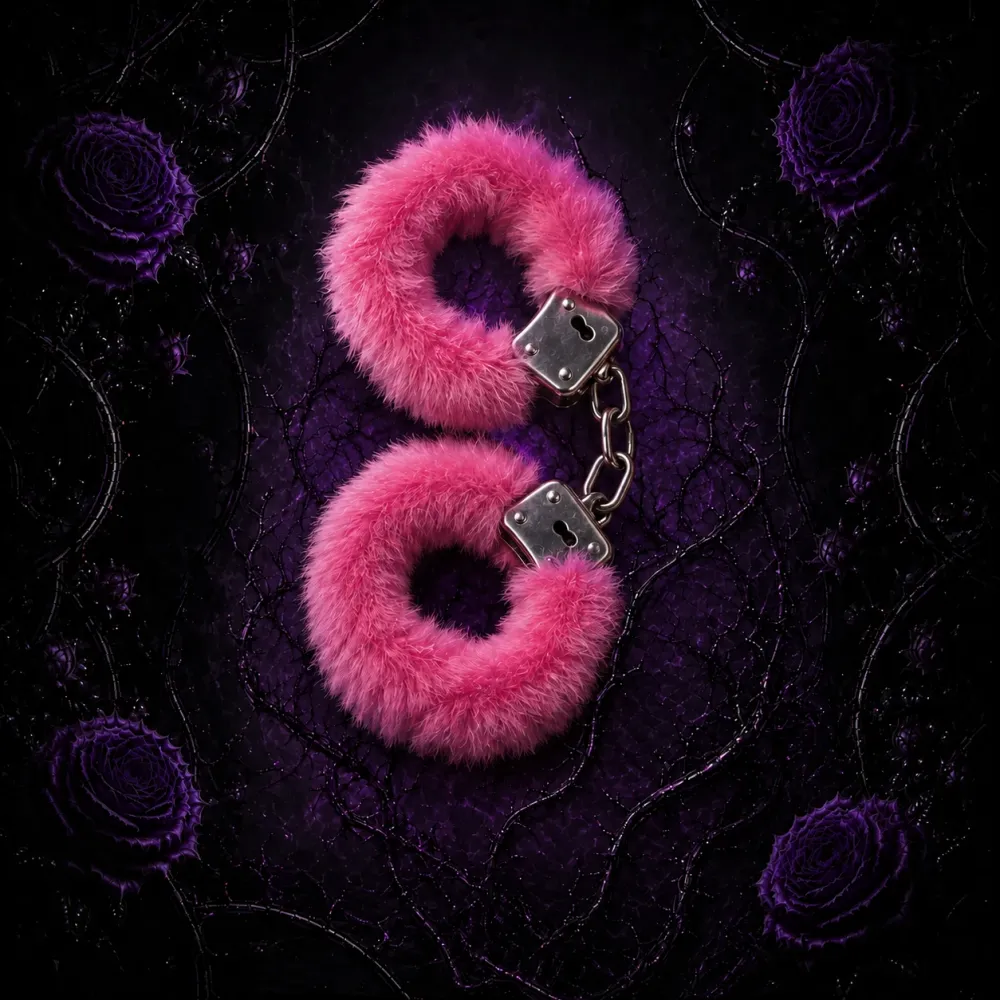
Next to the box lay a pair of handcuffs.
Pink. Fur, soft, fake, and under it — metal, a thin chain, a tiny key on a ring. He looked at them for a few seconds without touching them, and there wasn't a single thought in his head except that they weren't the same. Not those. Not the steel ones, heavy, cold, which he had bought himself and which still came to him in his sleep as links and weight. Different ones. Light. Made for play. From some other life, where handcuffs had fur and people had time to play.
"And what are these doing here..." he said out loud, quietly, to himself.
The lock clicked in the front hall.
The first thing he felt was relief — brief, warm: he's back. He didn't turn around right away; he was closing the cabinet, carefully, so that nothing pink would be left in sight, and had time to think that now he'd say something about the cereal, and that this would be, it seemed, the first thing he'd ever said to this person in the morning just because, for no reason — when a voice spoke behind him, and the voice was the wrong one.
"Oh. I see you've already found our toys."
He turned around.
Priscilla stood in the kitchen doorway — in dark red, her hair in a heavy wave, arms crossed over her chest. She stood there as if she'd stood there a thousand times, and from how easily she filled the doorway it was clear that she had. Simon had only ever seen her from a distance — across the cafeteria, down a hallway, through a car window — and up close she turned out to be shorter and more carefully put together than he'd thought: not one accidental line, not one strand out of place. Her eyes were lined so neatly it looked like a job, not a morning.
"Yes, Jacob likes to play with restraints." She walked forward unhurriedly along the island, her gaze sliding over the kitchen, over him, over the closed cabinet behind his back. "Have you two played yet?"
Simon was standing with the box of muesli in his hand. He put it down on the counter — slowly, so his hand wouldn't give anything away — and said:
"How did you get in here?"
"You really are stupid." She winced — lightly, fastidiously, as if at a smell. "The very fact that I have to explain this disgusts me. Look what I've got."
She raised her hand. A ring of keys swung glinting from her finger.
"I practically lived here. You didn't know?"
He said nothing. She dropped the keys on the counter — carelessly, with a jangle, the way you put a thing down in its rightful place — and looked at the box beside them.
"Mine," she said. "He keeps it for me. Nobody else eats breakfast here."
Simon looked at the box. Berries on the front, already opened, unlike anything else in this house. Of course. He didn't know whether it was true; he knew only that there was no way to check, and that she understood that, and that this was exactly why she'd said it.
"What do you want?" he asked. "Jacob isn't home."
"I know where Jacob is." She came around the corner of the island. "I started noticing it a long time ago — this strange, almost manic obsession he has with you. At first I even felt sorry for you. The poor outcast everyone picks on. I thought — well, it's entertainment. Boys will be boys."
"Keep your pity to yourself."
"But then I started noticing something else." Another step. Her voice stayed light, but the lightness was now resting on something she had to hold up. "You wanted his attention. You were always doing something to provoke him. Standing where he'd walk by. Watching. I saw how you watch him." A pause. "The whole university saw."
Simon didn't look away. That was the hardest part — not to look away when someone says out loud what you've known about yourself and never told anyone. But he could do it now: the day before yesterday, in the rain, and yesterday, in the middle of his father's living room. He stood by the closed cabinet and looked at her.
"I'm not going to discuss this with you."
"And now it all adds up." She was two steps away now. "I know about the nights. The one when he wouldn't pick up. Last night." Something wavered on the last word and immediately steadied. "You think he wants you? He's playing. Like always. Like with everyone who's ever come along. You'll never really be together — not because I'm against it. Because Jacob doesn't need that kind of shame. He'll tell you so himself if you ask. Go on, ask."
Simon was silent. Behind her was the glass wall, the garden, the gray day; behind him, the cabinet door with the pink thing inside. He heard what she was saying, and he heard how she was saying it, and the second was louder.
"Tell me one thing," Priscilla said. More quietly. The lightness was gone — not all of it, but what was left sounded memorized. "It doesn't mean anything, right? You just... happened to be there. The right moment, a bad week. He wasn't himself after that whole business with the police, and you turned up. Right?" She waited. "Tell me that's how it is."
He understood what she wanted. Not to humiliate him — that was just on the way. She needed him to say: I'm nobody. I'm an accident. You're fine, there's nothing wrong with you, Jacob's choice says nothing about you. That's what she had come for — with keys, in the morning, to a person she considered beneath her — and now she stood two steps away and waited for him to confirm it.
He could have. It wouldn't even have been a lie — he himself didn't know why Jacob kept him around. This was the second time he'd woken up in this house, and he had never once asked. "You're mine" wasn't an explanation. "Everything's going to be different now" wasn't an explanation. He didn't know.
"I don't know why he keeps me around," he said. "I haven't asked him."
"You know."
"Ask him."
"I did ask!" It came out louder than she meant it to: he saw her hear it herself. "I asked last night. I gave him..." She cut herself off. Straightened up. "It doesn't matter."
"Then why are you here?" Simon asked. Quietly, without anger — he genuinely didn't understand. "If he's playing. If I just turned up. You don't go to war with toys. You don't come for them in the morning, with keys, while the owner's out."
She opened her mouth — and didn't answer.
And in that second the anger she had been holding all this time beneath a smooth surface came out — not as a shout, but in the way her voice changed: it got lower, faster, and seams began to show in it.
"You think this is about you?" She stepped right up to him. "I don't care who he sleeps with. Another girl I would have understood. I'd have figured her out, taken her apart, taken back what's mine. It's not about you. It's about the way he looks at you." A pause in which she tried and failed to get the lightness back. "For three years I was perfect. Perfect, do you understand? Hair, grades, his mother, his father, his team — everything. And not once — not one single time — has he looked at me like that."
Simon looked at her and saw — for the first time — not the cheerleading captain, not the girl in the car, not the one Jacob smiled at in the cafeteria. He saw someone who had come to her rival so that the rival would tell her he was no rival at all. It was ugly and very understandable. He knew what that was like — waiting for someone to say the word that would put you in your place, because any place is better than none.
And he told her the truth — not to hurt her. Because this was the one thing he understood better than anyone alive, and staying silent would have been worse.
"He doesn't look at me like that because he loves me," he said quietly. "That's how he looks at what he thinks is his. You're jealous of a look that has to be paid for." He didn't look away. "If you got it, you wouldn't be glad."
Priscilla went still.
She didn't understand. He could see it in her face — she couldn't understand, and in that not-understanding, for one second, everything became visible as it was: she was desperately jealous of what he was getting, and he knew the price better than she did — and he was still standing here, in this kitchen, in someone else's T-shirt under his own hoodie, and not going anywhere.
"Say you're nobody," she said. Almost a whisper. "Just say it."
"I can't."
He heard the slap before he saw the movement.
His head snapped to the side; his cheek flared — the good cheek, not the other one. Now they were symmetrical. Simon slowly turned his face back. His mouth was hot and salty — yesterday's cut had opened again. He said nothing.
He looked at her, and she looked at her own hand, as if the hand had done it without her.
"Priscilla. What are you doing?"
A voice from the door.
She spun around, her whole body — and the transformation was instant, like changing the channel. The anger was wiped from her face without a trace; in its place bloomed a soft, warm, rehearsed tenderness.
Jacob stood in the kitchen doorway — red jacket, hair wet from the shower, bag on his shoulder. Simon saw his face before she could reach him, and it was a face Simon had never seen: heavy, dark, locked — and not against her. Not against anyone. Just locked, like after a fight that hadn't happened here. The first thing Simon thought was: it's because of me. Because I'm here. Because I opened the wrong cabinet. Because he came back and walked in on this.
"Oh, darling!" She was already walking toward him with a light step. "I was waiting for you. I didn't know you had company. You're finally back."
She rose on her toes and kissed him on the cheek.
Jacob didn't move. The kiss landed on stone. He was looking over her head — at Simon, at his cheek — and Simon couldn't tell what was in that look: anger, a question, something else.
"Priscilla." He didn't raise his voice. "You'd better go."
For a few seconds she looked up at him. The smile held, but her eyes changed.
"Fine..." she whispered, and there was nothing sweet left in the whisper. "I hope you understand where all of this could lead."
And then — again, as if at the flip of a switch — tenderness. She reached up and kissed him softly on the cheek once more.
"Okay, my love. See you on campus."
Her heels clicked down the hallway. On her way out she swept her keys off the counter — in one movement, without looking, the way you take what's yours.
Jacob didn't tell her to leave them. Simon heard it — not words, but that there were no words. The front door banged. Outside the window an engine started and faded away.
They were alone.
Simon stood by the island. His cheek burned — both of them burned now, each in its own way. He raised his eyes to Jacob, who was still standing in the doorway, bag on his shoulder, face locked, looking at him as if he hadn't yet decided where to begin.
Simon decided for him.
"I can't take this anymore," he said quietly. "We have to end it. All of it."
The bag dropped to the floor. Jacob crossed the kitchen in three strides and wrapped him up — gathered him in, pulled him close, buried his face in his hair. He smelled of the shower, grass, and the cold of the street; his jacket was icy, and under it — hot, heavy, alive. Simon didn't have time to decide whether he wanted this or not. His body decided first: it leaned in, his forehead came to rest on the other's shoulder, and for a second — one — it was good. Just good, no conditions. Like last night, under the weight of his arm, before falling asleep.
"Baby, I'm sorry." His voice was muffled, hurried, into Simon's hair. "I'll sort it out with her."
"Sort it out." Simon spoke into his shoulder. "Jacob, she loves you. She came with keys. That doesn't get sorted out with a talk." He swallowed; the cut in his mouth answered. "I just want it all to stop. It's only getting worse — for you and for me."
He felt the body holding him change.
Not right away. At first the arms on his back simply went still — the way a person goes still on hearing their name from the next room. Then they tightened. More. So that it was hard to take a full breath. Simon couldn't see his face, but he heard the breathing by his ear change — it grew slower, more even, and that evenness sent a chill down his spine.
"You're not going anywhere," Jacob said. Quietly. Very quietly. "You're mine."
"Let me go."
"No."
Simon braced his palms against his chest and pushed. It was like pushing a wall that had an opinion. The arms on his back didn't let go; one moved up and settled on the back of his head — fingers in his hair, palm against bone — and now held not just his body but his head as well.
Last night on the sofa, his fingers on a wrist had stopped everything. Today "let me go" stopped nothing. He understood this with the same clarity with which he'd understood, last night, that it had worked: the rule held where Jacob allowed it to. Here, it didn't.
And Jacob noticed. Simon felt it — a split-second hitch, when Jacob realized he was being pushed, that this wasn't an embrace in return but an attempt to get out. The arms froze for that second.
And didn't let go.
Jacob drew back — just far enough to see his face, without releasing him — and with the palm on the back of Simon's head turned his face toward him. Simon was looking away; he was made to look straight ahead.
"The last time you said you wanted to end it all," Jacob said, "I was sitting in chains watching you kill yourself."
Simon froze.
"You were lying three meters away from me. I was screaming. I couldn't reach you." His voice was even, terribly even, and only the fingers on the back of Simon's head were trembling. "I'm never going through that again."
"That's not what I meant..."
"I don't care."
He held Simon's face so that there was no looking away, and spoke straight into it:
"You can hate me. You can scream, fight, blame me — anything you want. But I'm not letting you disappear again. Not through that door. Not any other way."
Simon stopped pushing.
Not because he agreed. Because his hands, braced against the other's chest, had stopped changing anything, and keeping them there any longer was no longer resistance, only a pose. Jacob felt that too — his grip loosened a little, the palm on the back of Simon's head softened, ran over his hair, stroking. He leaned down and kissed him on the temple — in the same place as that morning; Simon recognized the spot.
"That's it," Jacob said quietly. "You don't need to go anywhere. Just stay with me."
Behind Simon's eyelids something burned. He wasn't crying — he just couldn't blink properly.
"Say you'll stay."
Over Jacob's shoulder he could see the kitchen door, beyond it the hallway, beyond that the front door. Ten steps. Maybe twelve. He looked at it and counted, and that was the only thing he could do on his own right now.
"Say it," Jacob repeated.
Simon wanted him. That was the truth, and it hadn't gone anywhere — not with the slap, not with "you're mine," not with the arms that wouldn't let go. He wanted this person and he wanted to walk out that door, and one didn't cancel the other, just as it hadn't last night. Only last night he'd been able to choose. Today he was being asked in a way that put the answer inside the question.
"I'll stay," he said.
Jacob breathed out — long, relieved — and pressed him close. The arms loosened. Didn't open — loosened; became an embrace rather than a lock; warm, heavy, familiar.
Simon stood in them and looked over his shoulder at the door.
Last night he had fallen asleep without checking where it was. Today he knew exactly: ten steps, maybe twelve. He didn't move toward it.
But he didn't take his eyes off it again.
The screen goes dark.
To be continued in the next episode.