Simon surfaced from sleep slowly, in layers, the way you come up from the bottom without knowing how much water is over your head.
The ceiling came first. High, smooth, white — not his. No yellow stain from the old leak, no crack he knew by heart, like a line on his own palm. The light was falling from the wrong side. What was under him was too soft, what covered him was too warm, and the smell around him wasn't his life: someone else's laundry detergent, wood, yesterday's rain left behind the glass.
His body reacted before his mind did — the old way: freeze. Don't move. Listen.
He lay with his eyes half-closed and listened. No television muttering downstairs. No creak of his father's chair. No street behind a thin wall. The silence here was dense, even, expensive — the kind that doesn't let other people's noise in.
Where am I?
Yesterday came back in pieces, out of order. Rain. The ditch. A rear wheel throwing up water. His own scream, torn down to a rasp. The taste of someone else's blood on his lips. Hands that caught him along with the dark.
After that, nothing.
He turned his head carefully. A window the whole width of the wall; behind the glass, a garden washed by the night: clipped grass, bushes heavy with water, a stone wall in the distance. The room was the size of half his house, and everything in it was expensive and quiet: not one thing asked to be looked at. He was wearing someone else's T-shirt — soft, loose, smelling of someone else's home. His own clothes, still dark with damp, hung over the back of an armchair: hoodie, T-shirt, jeans. A laundered map of yesterday.
So it hadn't been a dream.
— My baby's awake.
The voice hit him from the direction of the door. Simon flinched and sat up — too fast: the room swayed and reluctantly settled back into place.
Jacob stood in the doorway, shoulder against the frame — barefoot, at home, a glass of water in his hand. A dark crust had dried on his lower lip.
The mark had held.
Baby. The word pricked under his ribs, quick and hot. It should have set off the alarm: something always came after that word. Instead, something warm and completely out of place answered inside him. Simon put it down to weakness.
— Where am I? — His voice was hoarse with sleep. He already had a guess. He needed to hear it.
— At my place. — Jacob pushed off the frame, crossed the room and set the glass on the nightstand. Not into his hands — beside him. — You passed out right there on the road. Into my arms. I turned the car toward the hospital, and then I remembered you'd run out of one after a day. And that you asked me not to take you home. So your father wouldn't find out. Not about the ward, not about any of it. — He shrugged, as if reciting a lesson he'd learned. — So I brought you here.
Simon looked at him without speaking and searched for the catch.
There was no catch. Jacob had remembered. Both requests, word for word, with the reasons attached — though back then, in the hospital room, it had seemed he was listening with half an ear, in passing, already thinking about something of his own. Somewhere deep, under the ribs, something loosened — one turn, no more.
But it loosened.
— Drink. — Jacob nodded at the glass. — You haven't had anything in almost a day.
Simon took the glass — his hand barely shook — and drank it dry. The water was cool and somehow delicious, the way it only is after very bad days.
— My phone.
— On the dresser. Alive. Unlike your jeans.
Simon reached for it. The screen lit up: three messages from Ash, during the night and in the morning. "You didn't text." "Simon." "Answer me or I'll assume the worst." He typed: "Alive. Didn't sleep at home. I'll explain later." The reply landed before he could lower his hand: "Where?"
Simon put the screen out and laid the phone back down — face down. Beside it, on the same dresser, face down in exactly the same way, lay Jacob's phone. Nobody had turned it over all night.
— My bike, — Simon said.
— In the ditch. — Matter-of-fact, like the weather. — It had a dead wheel and a frame from my grandfather's day. I'll buy you a new one. Any one you want.
— That dead one was mine. — The ice in his voice took a thin crack, and an old grievance splashed through it. — And I needed it for one thing. So I wouldn't have to get into your car.
Jacob recoiled as if flicked in the face, but said nothing. He paced the room — three steps one way, three back; even in a big cage the animal was cramped — and stopped by the window, his back to Simon.
— About Craig, — he said to the glass. — You can stop worrying. I shut him down.
— Shut him down, — Simon repeated evenly.
— His family feeds off my father's factory. Father, uncle, brother — all of them. — Jacob turned around. He spoke evenly, without expression — the way you list tools, not trump cards. — As long as he has something to lose, he's on a leash. One word from me and they're all out on the street. He knows that. He'll keep quiet. — A pause shorter than a breath. — I take no pleasure in it. But it works.
— Then we have a problem, — Simon said.
— What problem?
— I shut him down too. My own way. — Simon looked at him without expression, and every word fell heavier for it. — Yesterday I went to the director. I told him about the three years. About the hall — with witnesses. Ashley confirmed every word, and Ashley's word carries weight with the administration: she has the paper behind her. The director understood one simple thing: either he reacts, or the whole university reads about it. — A pause. — Craig will be suspended. Most likely expelled.
For a few seconds Jacob simply looked at him.
Then it got through to him.
— What?.. — He stepped away from the window. — You... you turned him in to the director?! Yourself?!
— Are you surprised? — Simon's eyebrow rose barely at all. — You're the one who taught him I could be hit. I just removed him from my life.
— You don't understand what you've done! — Jacob broke into a shout. Now he was tearing around the room like an animal in an enclosure, unable to stop. — He knows, Simon! He saw us! While he's at the university I've got him: the factory, the team, all of it! Expel him and there's nothing left to hold him with! A man with nothing to lose is a grenade with the pin out! Do you have any idea what he can do? To you! To— — He caught himself.
— To me? — Simon tilted his head slightly. Something thin and vicious seeped through the ice again. — Or to you, Jacob? Finish it. — He put his feet down off the bed and got up; straightening had to be done slowly, but he straightened and stood facing him. — I have no secrets. I have nothing to lose — I've already lost everything. You're the only one hiding here.
— You let him off the chain, — Jacob said dully.
— You forged the chain. Three years of it. — Simon walked past him to the armchair, to his clothes. — Deal with your own dog yourself.
He didn't get two steps.
A yank — the world spun, his back hit something soft, the bed gave and took him. The weight of another body came down on him; strong fingers caught his wrists and pressed them into the sheet above his head — one movement, as practiced as turning a key.
— Enough. — Jacob growled it into his face. He was breathing hard; his pupils had eaten almost the whole iris. — Stop talking to me like I'm nothing!
Move. Knee him. Scream.
His body didn't obey. His body wasn't listening to him at all.
Under the crust of ice, everything Simon had been muffling for weeks surged up at once: heat, fury, the old starved pull — one suffocating tangle where the threads couldn't be told apart anymore. His breath broke. His fingers moved under the grip — not away, not to pull free.
Toward it.
There it was, the filthiest part of his secret — deeper than the schedules, deeper than the learned routes, deeper than anything he had ever admitted to himself. He liked it. He liked this grip that asked no questions, this weight that left no choice, this mine in which his own no meant nothing. For three years he had called it fear, because fear can be forgiven. But when Jacob held him like this — hard, with all of himself, with no right to escape — the world became as simple as a blow. There was nothing to decide. Nothing to fight. No need to be. There was only belonging — and the hungry, shameful, prewar part of Simon wanted the bottom of that hierarchy so badly it set his teeth on edge.
He could still choose the cold. He knew how: close his eyes, breathe out, turn his face to the window and leave Jacob an empty, obedient shell. That was how he had always survived.
Simon didn't turn away.
He breathed out — and stopped resisting. He didn't go limp, didn't give in. He simply let his body lie where it had been put. The difference was thinner than a hair.
They both felt it.
Jacob went still. He looked down at a person who had just stopped fighting him and didn't understand what he'd won — or whether he'd won anything at all. His gaze slid to his own hands: fingers ringed around someone else's wrists, knuckles white. And above his own palms, from under the ridden-up sleeves — pale, fading stripes on the skin.
Where the steel had been.
The country house hit his memory backhanded: the chair by the fireplace, the coils biting into his wrists at every movement, his own helplessness, huge as the night outside the windows. And a person beside him who had lain just like this, turned away, and said nothing.
The grip loosened on its own.
— Please. — Every drop of command had drained out of Jacob's voice; what was left was bare. — Stay with me. A little while. Then I'll take you wherever you say.
Simon lay there and looked past him at the high, unfamiliar ceiling. Say no. Get up. Leave. It burned under his eyelids. His fingers, crushing the sheet, slowly unclenched.
He stayed.
And for the first time he didn't look for excuses for it.
The director's office smelled of old wood, leather and paper — the smell of decisions that are made unhurriedly and never reversed. Craig sat in the chair across the desk — the same one Jacob had sat in not long ago — and tried to hold his usual pose: knees apart, elbows on the armrests, boredom on his face. His fingers gave him away. They had dug into the leather of the armrests until the nails went white.
— Information has reached the administration about systematic abuse of students. — The director spoke dryly, laying papers out in front of him and squaring their edges. — There is a formal statement. There are witnesses to the assault in the hall. And there is a student paper ready to make this story public. — He raised his eyes. — The university cannot afford a stain like that on its reputation. That is why I am obliged to open an inquiry. As of today you are suspended from your studies — until it concludes.
Craig jumped up. The chair shrieked its legs across the parquet.
— You can't! Because of one word from some—
— The decision is final and not open to discussion. — The director took off his glasses and looked straight at him — tired and without any fear at all. — I warned you that from now on I would be watching everything that happens on this campus closely. Dismissed.
The last word landed like a folder snapped shut.
Craig stood there a second longer — big, heavy, suddenly superfluous in that quiet room. Then he turned and walked out without closing the door behind him.
The leash had snapped. And nobody in that office gave a thought to what happens to a chained dog when the chain no longer holds him.
Ashley was standing at her open locker, going through her notebooks, when someone's arm swept past her shoulder — and the door slammed shut right in front of her face.
She flinched — from surprise, not from fear — and turned around.
Craig. Red, his breathing off, with that same fury in his eyes she had seen so many times aimed at other people. Up close he turned out to be bigger than she remembered. His shoulders blocked half the corridor.
— What the hell, Craig?
— You tell me, Blue Hair. — Nothing was left of his usual lazy smirk. — That faggot got me suspended. Expulsion is next. Why did you back him up?
— Back him up? — Ashley looked at him calmly, straight on, from below — and still managed to look down at him. — It isn't Simon sinking you, Craig. Your own fists are sinking you. I just showed everyone where they'd been.
— I thought you and I—
— You and I are nothing. Never were. — Her eyes narrowed slightly. — You're confusing being liked with getting on someone's nerves.
A fist crashed into the locker beside her head. The metal boomed, a deep dent spread through the green paint. Ashley didn't flinch back. Only her fingers tightened a little on the notebook.
— Tell your freak. — Craig leaned in toward her face, and his voice dropped to something quiet; the quiet was worse than the shouting. — I've got nothing left to lose now. And I remember very well where he lives.
He straightened up and walked off down the corridor without looking back. Students moved out of his way the way they always had, along a trajectory learned over years — not yet knowing that they were making way for a man who had just had every reason to stop taken away from him.
Ashley stayed where she was by the buckled door. She wasn't afraid of Craig — she never had been: fear was a currency she refused on principle to pay. But now, watching his back, for the first time she felt something ache inside her, thin and unpleasant.
Not for herself.
She dialed. The rings went out into emptiness — one, three, five. Then she wrote: "Call me. Urgent" — and stayed standing there, looking at the screen.
The screen said nothing.
The day in someone else's house went by as if it had been handed to him by mistake.
Simon slept again — his body taking back everything it was owed for all those nights at once, dropping into sleep without warning, in the middle of a thought. He would wake up: there was food on the nightstand — toast, broth in a heavy white mug, water. He ate. At first because his body demanded it. Then because it was good, and because someone had warmed it for him, and he couldn't remember when that had last happened. Jacob appeared and disappeared without asking anything; somewhere downstairs his voice worked away, muffled — one short call, then another. By evening the rain had gone for good, the sky over the garden had faded to gray-yellow, and the light in the bedroom stood low and honeyed, the way it does in rooms where someone is getting well.
When Simon woke for the third time, the mattress beside him sank.
Jacob lay down on top of the blanket — dressed, a hand's width away, looking at the ceiling. He lay like that for a while. The border held for about a minute and a half.
Then he simply pulled Simon over to him — back against his chest, not roughly, but without asking either — and put a heavy arm around him.
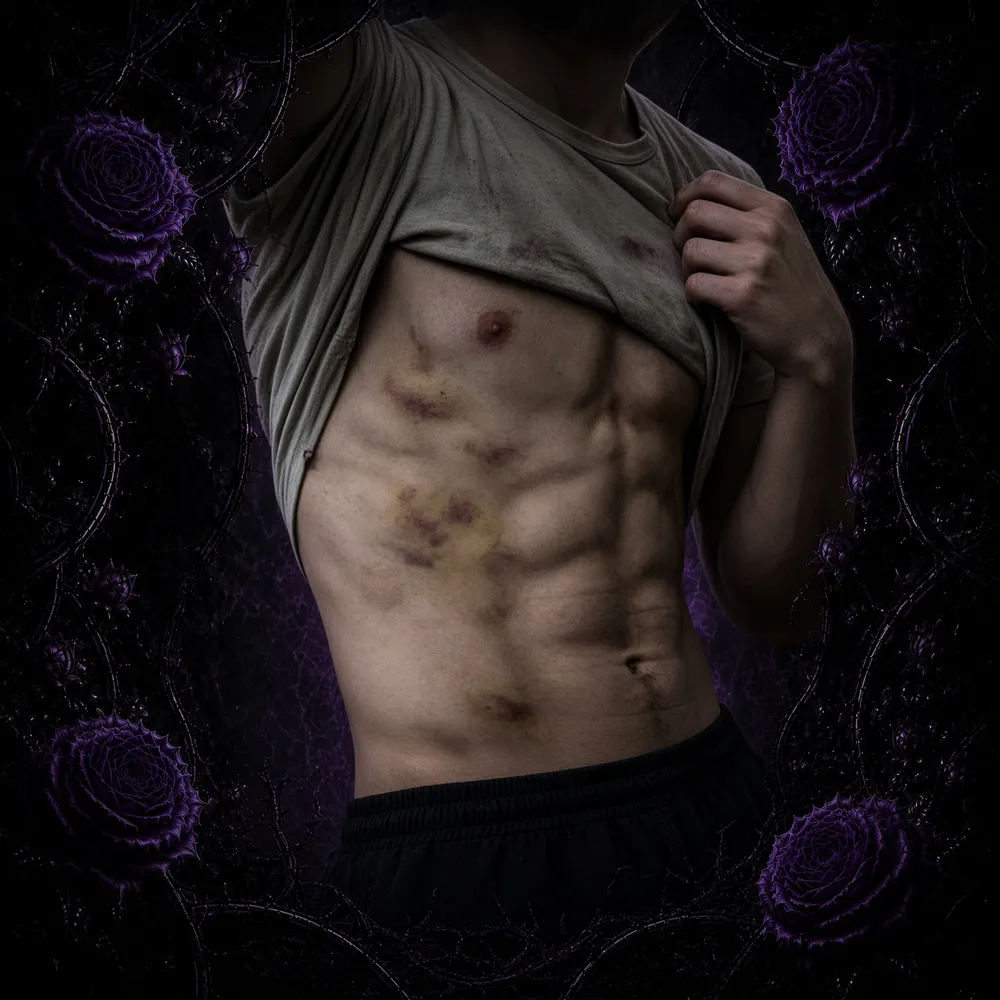
At first he touched him over the fabric. Slowly, thoroughly, like an owner — as if he had finally been given permission he had never asked for. His palm went along the shoulder, settled on the shoulder blade, traveled down the spine — through the thin T-shirt every vertebra read under his fingers like a line of text. His fingers traced the ribs and went around the bruise along its edge, not touching it — the way water goes around a stone. They rose to the back of his neck, buried themselves in his hair, went through the strands once, twice, aimlessly, just because they could.
Jacob raised his hand — only to move a strand that had fallen across Simon's face — and a shudder went through Simon, short and deep, the way you jolt in your sleep when you're falling. His shoulders flew up, his breathing stopped, his whole body gathered for a fraction of a second into one knot with a single learned meaning: he's going to hit me.
A hand raised over him had always meant one thing. Two people had taught him that. One of them was lying behind him now.
Jacob froze with his hand in the air.
He knew that shudder. He had caused it himself — deliberately, for years; he knew its taste. And now it answered in him with the same dark, thick, shameful thing — for one second he wanted to hold his hand there in the air. A little longer. Just so the shudder would last.
I just like having him here, Jacob told himself. I like the house being quiet. I like that he isn't going anywhere.
Convenient words. He had always been good at picking them.
He lowered his hand — slowly, along a long arc, in Simon's sight — and moved the strand off his face, barely touching him. And after that he moved differently: slower, always in view; his palm came down where Simon would see it before he felt it. He didn't press and didn't hurry. Patience sat on him like someone else's clothes in the wrong size, but he wore it.
Little by little the shudder went away.
And then Jacob's palm found the hem of the T-shirt and slid under it — onto bare skin.
Simon breathed in and didn't breathe out.
The palm was large, hot, a little rough; it lay across his stomach whole, and from that simple thing — skin on skin — a wave went through him that had nothing to do with fear. The fingers moved higher, slowly, over the ribs, counting them; went around the sharp bone at his hip; came down to the very edge of his thigh — and came back. Every movement was unhurried and thorough. Jacob touched him as if he were rewriting this body onto himself from scratch.
And the body agreed.
It thawed faster than Simon could keep control of it: the skin under the other man's palm burned, goosebumps scattered up his arms, his breathing broke and went uneven. The warmth — heavy, dragging — ran down his belly, to where it could neither be hidden nor written off as weakness.
Jacob felt it. Of course he felt it — by the way the breathing changed, by the way the stomach under his palm pulled in and immediately pushed up into his hand. He didn't say anything. Only his lips found Simon's neck — from behind, under the hair — and went along it slowly, almost without touching: breath, contact, breath. Right at his ear. Down, to the shoulder, pushing the collar of the T-shirt aside.
Simon closed his eyes.
He should have stopped it. The word was short, he knew it — no, one movement of the lips. Instead he turned his head — himself — opening his neck. And heard Jacob breathe out behind him, short and low. Like a man who has just been given permission.
After that it got worse. Or better — Simon couldn't tell the difference anymore. The palm on his stomach pressed with heat; the lips at his neck grew insistent — no longer breath but touch, pressure, a short wet trail behind his ear that sent a jolt of current through his whole body. Simon caught himself pushing back into that warmth, back into the chest behind him. Caught his own fingers finding the other man's hand on his stomach — not to push it away.
To press it harder.
He wanted more. More weight, more hands, more of that mouth on his neck; he wanted to turn over and— he cut the thought off, but his body finished it for him: rocked back, pressed its shoulder blades into the chest behind him, gave him away completely. Somewhere at the very bottom the watchman was still sitting there — the one who had spent a lifetime counting other people's hands as a threat. Even now he flinched from time to time, when a movement came too sharp or fingers settled too close to his throat. But the watchman was drowning. The warmth was closing over his head, and for the first time Simon wasn't trying to save him.
Jacob held himself on the very edge. He felt every response — the caught breath, the goosebumps under his palm, that movement toward him — and every one of them made it tighter and darker inside him. He wanted more. Now, immediately, all of it: three years of hunger reached for this body with both hands. But he moved slowly — because for the first time he was seeing how this body answered when it wasn't rushed. He didn't press. He waited. That was power too — new, fine, sweeter than the old kind. Jacob didn't ask himself why.
The light in the room had long since burned down to blue. In the darkening window their shared reflection floated — blurred, out of focus, like a photograph taken with an unsteady hand.
Jacob's palm stopped on Simon's side — where, he knew, the darkest of it was blooming under his fingers. He held it there without moving, warm and heavy, as if the mark could be covered by his own body, the way you put a palm over a crack in glass.
He didn't know how to say sorry. The word came from another language — the one where you admit a debt and call things by their names. But something had to be said; the silence was pressing on his chest from the inside. He decided to ask. Just to ask — so Simon would understand that he saw. That he cared. It seemed safe.
— Where did you get them, baby?
Silence. Only the garden behind the glass, the settling dusk, and someone else's breathing — even. Too even.
The warmth drained away all at once, to the bottom.
Simon was quiet for a long time. So long that Jacob had time to decide there wouldn't be an answer — and almost to be glad of it.
Then Simon turned his head.
His eyes — straight into Jacob's, point-blank, from less than a hand's width away. In the dusk they looked completely dark, and there were no tears in them and no anger. Only an even, frozen cold.
— Why are you asking... — he said quietly, in a voice without a single burr, — ...when you know the answer.
Jacob didn't look away. He couldn't — it was as if he were being held by the back of the neck. His palm stayed where it was on the other man's side, warm, heavy, caught out: it managed neither to close nor to leave. Under it, through the skin, someone else's heart beat evenly and calmly.
It had known everything for a long time.
Jacob had no answer. Not to the question, not to the look. The words that needed to be said didn't exist in his language.
So he did the only thing he knew how to do. He pulled Simon back against him — tight, with all of himself, leaving no air between them — leaned down to his ear and said in a whisper that made the back of Simon's neck seize:
— Baby. Everything is going to be different now.
Simon didn't answer.
But he didn't pull away either.
Two phones lay on the dresser, face down. One of them buzzed briefly — and went quiet.
Nobody moved.
The screen goes dark.
To be continued in the next episode.