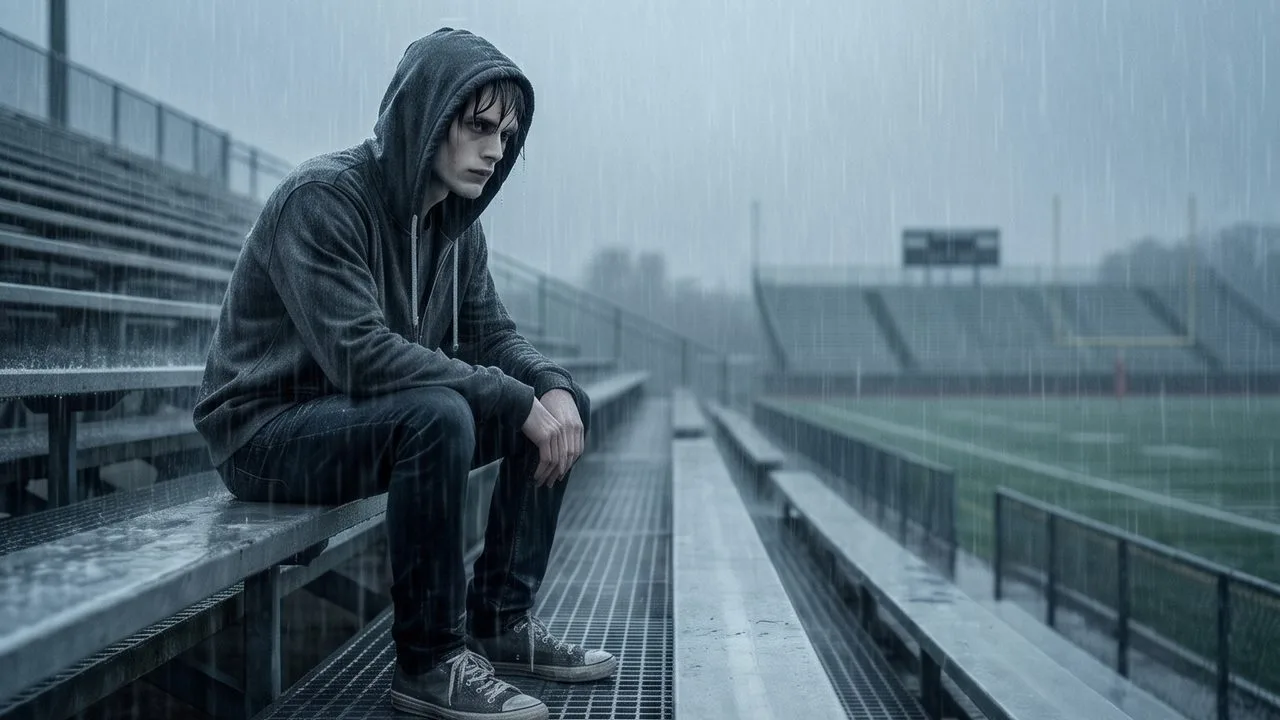
The rain had been falling for three hours, and Simon didn't feel it.
He sat on the top row of the empty bleachers, his hood pulled low, and the water had long since found every road inside — it ran down his collar, soaked the hoodie through, glued his hair to his skull. Below, under the grey wall of the downpour, the empty field was drowning. The cold should have wracked him with shivers — but the cold, like everything else these days, didn't reach him. Between Simon and the world there now stood a buffer of even, glassy silence, and the world scratched at it ever more faintly.
Several days had passed since the locker room.
By now the campus had watched the video to the end — all of them, down to the last freshman. Simon felt it on his skin as he walked the corridors: phones half-raised, snickers, conversations dying down as he approached and reviving behind his back. That's the one, with the soda. He had become a local landmark, an exhibit no one asks permission to inspect. A week ago it would have destroyed him. Now it bounced off before it landed: everything hurled at him from outside shattered against the same thing — against that new, cold thing growing inside him that asked only for time.
The image came every night now.
The same one that had first flared and gone out at the edge of sleep: the dull gleam of metal in the dark. With each night the frame held longer and grew sharper — now he could make out heavy links running up somewhere, drawn taut to a ringing tension; now the weight of the iron on the wrists could be guessed at. And this night Simon had finally made out whose hands they were.
Powerful. Tanned. Shackled overhead — fast.
Jacob. The perfect, untouchable king of campus — immobilized, stripped of his strength, his retinue, the voice with which the world spoke. Helpless. Waiting.
And staring into the dark where that frame was burning down, Simon for the first time managed to put into words what had been ripening in him all these days. Not exposure — exposure hands him over to others. Control. Full, total, undivided control over the one who had destroyed him — over his body, his will, his every breath. So that no one, ever again, could reach Jacob. No one but him.
From the inside, this thought didn't look like madness — it looked like the only honest thing. Everything that had passed between him and Jacob — the blows, the darkness, the secret — belonged to the two of them alone; no one else lived there, or had any right to. The world had watched it for years and not stepped in. So the world had forfeited its say. Now it was too late.
Simon's face, at this thought, expressed nothing — not pain, not fear, not triumph. Only the rain ran down it, as down glass.
He didn't yet know how. But how was already a question of technique. What remained was to ripen.
Ashley Cooper had noticed them long before it became a story.
Noticing was her profession. At twenty-three, Ashley headed the student council and the university paper at once — blue hair, heavy-framed glasses, and a reputation as someone you don't argue with twice. She knew this university the way you know a mechanism: which cog sits where, what squeaks, what's been tightened and by whom. And she kept lists. Neat, dated, with names and witnesses — lists the student council would have preferred left unwritten.
The habit wasn't born here. Back in school Ashley had learned a lesson that made her who she became: they were quietly squeezing out a boy from her year — methodically, over months, in plain sight of everyone. Twice she went to the administration; twice she was politely heard out — the school was preparing for its anniversary just then and awaiting donors, and no one meant to spoil the façade. The boy vanished — transferred, dissolved, became a footnote. And her first-ever piece about it was pulled from the school paper an hour before printing. That was when she understood the main thing — for the rest of her life. The lever is a system's fear for its own name. From then on Ashley never asked anyone for anything. She came with a folder.
Ashley had grown from the kind who drag their own wars to the finish themselves: taught herself, made her own way, carried the paper, the council, and half the campus's unspoken life on her own back. She had her own network — the porters, the lab assistants, the kids on serving duty in the cafeteria who knew her by name — and she knew more about this university than its own administration did. Ashley considered this the normal state of things.
Jacob and his circle had been in her lists for a long time — but, to her own vexation, as a single thin line. Over a couple of years little had accumulated there: a shove at the lockers, a tripped foot, a word thrown after someone. Ugly, unpleasant — but in public Jacob worked cleanly, and all of it stubbornly read as the ordinary needling of an alpha who'd gotten above himself. Not an article. Not even a note. Ashley recorded it — and waited.
Once, though, she had gone up to him. Jacob had just peeled himself off Simon, pressed into the lockers, and walked away with his crowd, laughing; the quiet boy stayed standing, staring at the floor and clutching a notebook to his chest. — You okay? — she asked, stopping beside him: she needed to understand what was really going on between those two. — I'm fine, — he answered instantly, by rote, without lifting his eyes. And left. That was the whole of their acquaintance: two people from the same year with nothing to say to each other. One more line went into the list — and lay there without moving for two years.
And then came the cafeteria.
Ashley herself hadn't been there. The video caught up with her by evening — in three copies, from three different angles, with the same laughter off-frame. She watched all three. Then once more, with a notebook this time. This was no longer needling — it was a public execution to general laughter and a hundred raised phones, and from the offhand way Jacob let the napkin drop onto the wet head, it read clearly: that's not how things begin. That's how they continue. And her editor's eye caught one more thing — the thing that turned her truly cold. The boy himself. He hadn't jumped up, hadn't shielded himself, hadn't cried out — he sat under the pouring soda motionless, head lowered, the way one sits under a long-familiar rain. Which meant that all this time, beneath a thin line in her list, something far heavier had been lying — and she had looked and not seen it.
The anger was real — down to clenched fists, to a sleepless night. But anger, like pity, is not a lever. So next Ashley did what she did best: she counted. Soberly, without panic. The soda clip by itself was no scandal: they'd laugh at it a week or two and forget — the campus had digested worse. But she saw the trajectory. The soda was not a finale but a step; which meant there'd be a next time, and another, and one day someone's phone would catch what could no longer be digested — the thing after which the headline the university where students are hazed on camera would write itself. And her paper's masthead bore this university's name, and her own four years were stitched into that name for good. This had to be put out now — while it still fit into a single folder.
She came to the director the next day, at nine, with the folder: dates, witnesses, a timeline — and a flash drive with the video. And there, in the office, Ashley deliberately did the thing she had no intention of blaming herself for: she raised the temperature. She presented it not as "an unpleasant clip" but as the first symptom: she laid out the trajectories, named the worst-case scenarios — a repeat, publicity, inquiries, questions from the trustees. The phrasings she chose were the ones that put a chill down a system's spine — because what she needed was not the director's sympathy but his fear. And because, to call things by their names, she needed Jacob gone from this university. The director listened to her for seven minutes without interrupting. He watched the clip once, to the end, and visibly paled — from there his imagination worked on its own, without her help. Then he was silent a long while, looking at the folder.
— I need the injured party, Miss Cooper, — he said at last. — Confirmation from him himself. Without that, all of this is rumors and one clip with no context.
— You'll have your confirmation, — Ashley answered.
What remained was to find the injured party. She was told the quiet boy from her year now sat for hours on the stadium bleachers — alone, in the rain.
The black dome of an umbrella rose over Simon soundlessly — and the downpour ended. Not for the world: for him alone. The rain still thundered on the taut fabric half a meter above his head, but not another drop fell on him now, and the sensation was so unfamiliar that Simon didn't at once understand what had happened. In his whole life there wouldn't have gathered a single memory in which someone had held a shield over him like that, in silence. He had no time to grasp it, or to weigh it. But somewhere inside it was recorded.
He slowly raised his head. For the first time in two years Ashley saw him up close — and barely recognized him. A deathly pale face, dark hollows under the eyes, wet strands stuck to his forehead beneath the hood. But that wasn't what made her inwardly miss a step. The eyes. She had come here to a crushed, broken person — and eyes looked back at her, even and empty as a switched-off screen. No grief. No fear. None of what she had prepared to console.
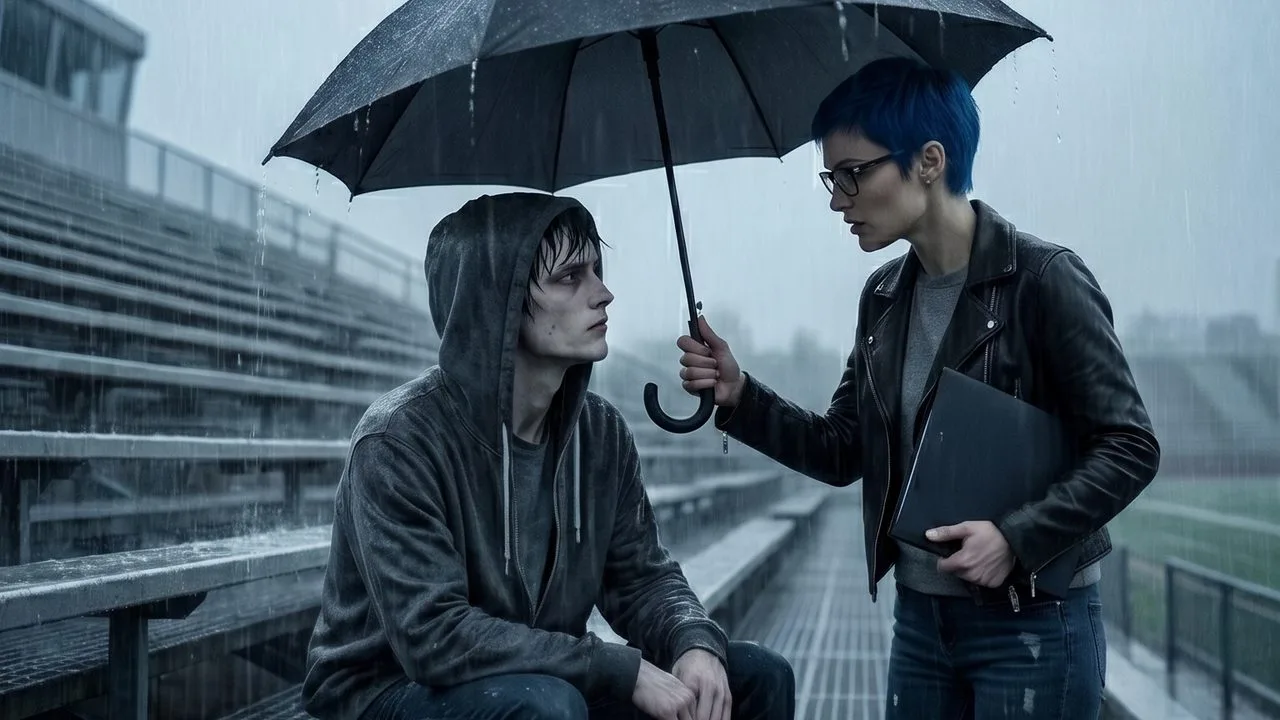
— Simon. We need to talk, — she said sharply, because gently was something she couldn't do.
He was silent.
— I saw what happened in the cafeteria. It's horrible.
— I don't want to talk about it, — he answered dully, and turned away toward the field. Someone else's pity was an irritating hindrance right now — like a fly landing on a blueprint.
But retreating was something Ashley couldn't do either.
— Jacob abuses his position, — she went on firmly. — He touches you because he knows you can't fight back.
The words pricked — brief and exact, like a needle going into an old bruise. Can't fight back. She'd said it without pity, as a fact — and it was a fact. One more jab at the same spot: at what he was. A nobody you could douse with soda in front of a hundred people — and it would just wipe itself off. Everything he could set against that lived only in the dark under his eyelids — taut links, strong hands shackled overhead. Not fighting back. For now — only a picture. But he held on to it, because it was the one place in the world where he was not a nobody.
— I can stand up for myself, — he said, grim, level, and that levelness so jarred with his whole appearance that Ashley faltered for a moment.
And she laid out the main thing — what she'd come for:
— I couldn't watch him humiliate you in public any longer. So I told the director everything. Everything, Simon: dates, witnesses, the video. — She held a pause. — If you confirm what I've said, Jacob will be thrown out of the university. For good. He's finished. All that's left is your word.
The words fell into Simon like stones into a well — and fell a long, terrible time before reaching the bottom.
Thrown out. Expelled.
He saw it instantly and whole, the way one sees a catastrophe: Jacob — vanishing. Leaving. Dissolving somewhere out there, in the wide world — unreachable, alien, free. From his days, which for years had held together on this one man like on a single nail; from his nights; from that future he had only this night made out to the end for the first time, and which so far existed only in his head. Led away. Taken. This girl with the umbrella, with her folder and her righteousness, was wrecking all of it.
And not she alone. Behind her Simon suddenly saw them all at once — the director, the committees, the protocols, that whole vast, blind mechanism years too late, which now, catching itself, was reaching its hands toward Jacob. Toward his Jacob. For years no one had cared. And now they were taking from him the one thing he had left — and calling it rescue.
The frightening calm flew off his face in a single second.
— Ashley, why did you do this?! — He broke into a shout, leaping up from the bench so abruptly that she stepped back. — What the hell are you doing, ?!
Ashley froze. Blinked. She thought she'd misheard.
— Into your... — she said it slowly, syllable by syllable, like a word in a foreign language, — ...relationship? — And she choked on the absurdity. — Simon, wake up! There's no relationship here! He's not "your" anything — he's just tormenting you! For years! It's called bullying!
Simon looked at her through the rain, and in his eyes there wasn't a shadow of doubt — only a dull, black, final hatred. He stepped out from under the black dome — the first shield ever raised over him in his life — back into the downpour. On his own.
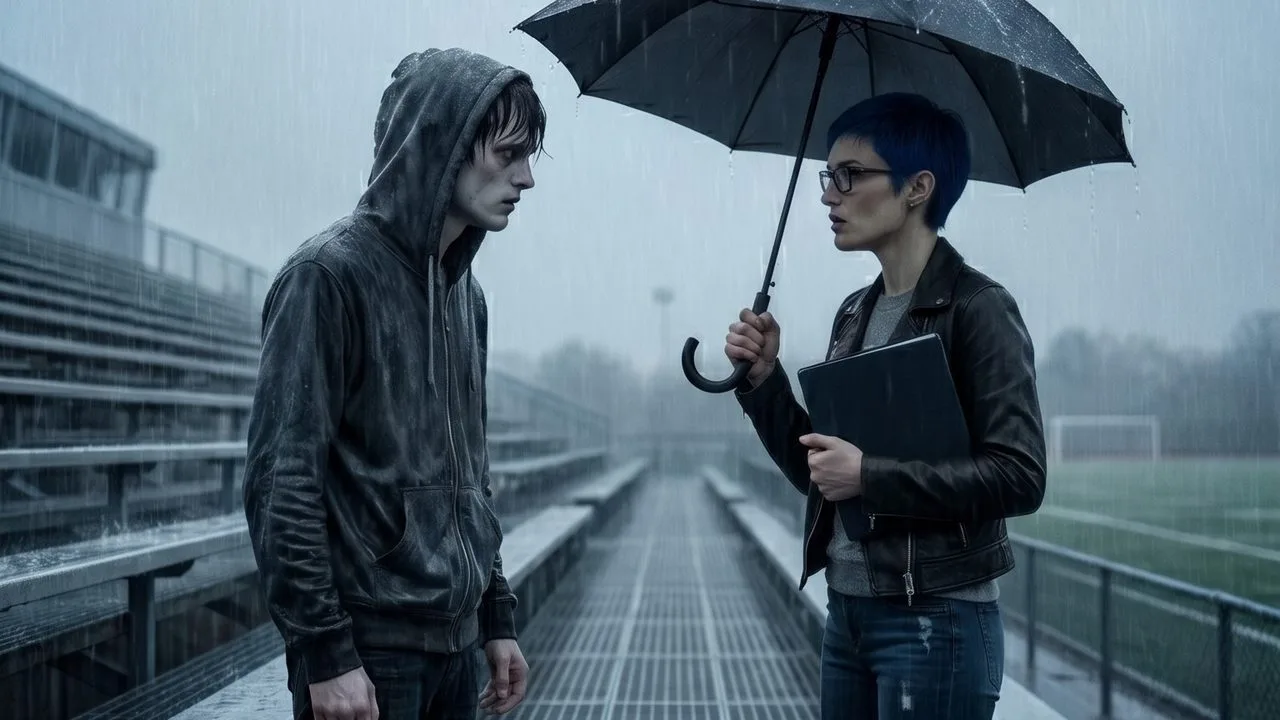
— You'll ruin everything, — he hissed. — Ashley. Back off. From us.
And he walked away, down the wet bleacher steps, without looking back.
Ashley stayed standing under the umbrella, watching him go, and for the first time in a very long while she didn't know what to write down. Her professional memory clicked and saved the frame — his eyes in the second he said ours. Something in this story was off. Deeply, heavily off — not along the column she'd filed it under. She had come to save a victim. But the person now walking away from her into the wall of rain looked least of all like a victim being saved.
And Simon walked under the downpour, not making out the puddles, and in his head, cold and clear, a countdown was already ticking. The flywheel was set going — he knew that for certain now. The director, the folder, all that's left is your word. The system has its own move: they'll summon Jacob, summon him, start asking questions. Days. He had days left, not weeks — and that number didn't frighten him. It gathered him, like the command on your marks. He had to act before they did.
The icy water flooded his eyes, ran down his dead, calm face. And beneath the countdown, deeper than everything, crowding out all the rest, maniacally, in time with his steps, beat one single possessive thought:
Fuck.
The screen goes dark.
Continued in the next episode.