The cafeteria at lunch was like an aquarium with too many fish dropped into it.
The noise stood thick and layered — the clatter of trays, the scrape of chair legs across the floor, hundreds of voices braiding into one even drone. And beneath that drone lay , only more visible. At the center, under the best light, by the big windows — the tables of those who decided what today would be like for everyone else. The athletes, their girlfriends, laughter that reached even the ones it wasn't meant for. And along the edges, by the walls, nearer the trash cans and the exit — everyone else. The tolerated. The ones people tried not to notice.
Simon sat in the far corner. Alone.
In front of him stood an almost untouched tray — he'd taken food only to earn the right to sit there, so as not to stand out even by the absence of a plate. Headphones were in his ears. The music — old, loud, someone else's — beat straight against his eardrums, and Simon pressed himself into it like the only wall available to him. It was his shelter. His way of leaving the room without rising from his chair. If you turned the volume up loud enough, you could almost convince yourself that none of this — the aquarium, the center, the edges, the strangers' eyes — existed. That he was alone. Truly, mercifully alone.
Almost.
Because even here, behind a wall of other people's guitars and drums, his head wasn't empty. In his head, as it had been all this time, was Jacob.
Simon hadn't summoned him. He'd have given anything to evict that image from under his own skull. But Jacob came on his own — uninvited, brazen, filling everything. Even now: the moment Simon closed his eyes for a second, a picture unfurled beneath his eyelids without any permission. Not a blow. Not a taunt. Not someone's fingers on his throat.
A kiss.
Right there, in the empty hallway, his back pressed into the cold metal of the lockers. In this fantasy Jacob bore down on him with all his weight — big, hot, heavy — and he smelled the way he always smelled: of heated skin, of someone else's sweat, of a letterman jacket, of something tart and unmistakably male that turned Simon's head to fog. One of Jacob's hands pinned him roughly to the lockers, not letting him move. The other rose to his throat — and strong fingers closed around his neck, not to the point of pain, but in a way that left no doubt whose power this was and who was master here.
Jacob kissed him greedily, cruelly, like he owned him — the way he did everything else. He breathed hard, fast, ragged, straight into Simon's lips, and there was far more hunger in that breath than tenderness. He was taking. Finally taking what Simon had for so long, so shamefully, so agonizingly, so desperately wanted to give him. And in this fantasy Simon didn't fight free — he pressed toward him, opened under the other man's force, melted into it, and somewhere at the very bottom, choking on shame, he wanted only one thing: for the fingers on his throat to tighten harder.
The vision was so dense, so hot, that Simon's breath truly caught. Heat shoved downward, tight and shameful, blood pounded in his temples, and his cheeks flared — right here, in the middle of the crowded cafeteria, out of nowhere.
He flung his eyes open, gulping air.
He hated Jacob. Hated him with everything still alive in him — for every bruise, every humiliation, all the ruined years. It was real, honest, hard-won hatred, and of it Simon had no doubt for a single second.
So why — he found no answer, and it was slowly driving him mad — why had the one he hated so much taken up residence under his skull and refused to leave? Why did the hatred and that second, shameful, pulling feeling turn out, again and again, to be one and the same thing, growing from a single root?
He didn't know. He only felt sick. Broken. And guilty — as if he himself, with his own hands, had let this rot inside him.
A shadow fell across his tray before he could pull out his headphones.
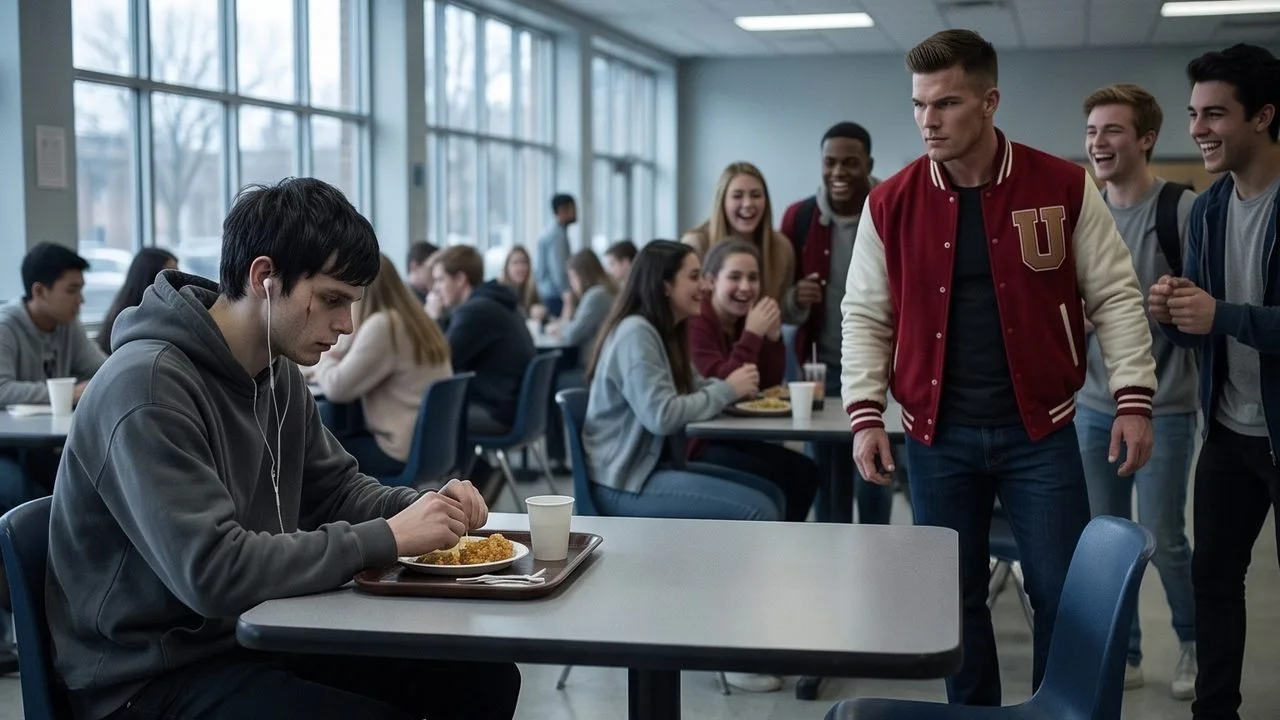
Jacob hadn't meant to come over. Or rather — he'd told himself he hadn't. He'd been sitting at his table, in the center, in his rightful light, in the familiar cocoon of noise and other people's attention, and everything was exactly as it should be. Except the morning wouldn't let go. Idiot. Quiet, trembling — and for some reason lodged under his skin far deeper than it had any right to. The mouse had bared its teeth. And from that moment Jacob kept catching himself searching out the gray corner by the far wall. Unable to just leave it alone.
He'd told himself the kid needed to be taught a lesson. Put in his place, reminded of who was who. It sounded clear and weighty — and it was a lie, covering a truth far simpler and far more shameful: he just needed to be near him again. To see Simon flinch. To catch again that sharp, incomparable lift, without which the day stayed gray and empty.
He stood, grabbing an open bottle of cola off the table.
— Where you going? — Craig tossed lazily after him, not looking up from his phone.
— To have some fun, — Jacob answered without turning around.
Simon pulled out one earbud. He looked up at the figure that had risen over him — and everything inside him clenched into a cold knot, the way it always did.
— Jacob. What do you want?
Jacob smiled — wide, for show, for the whole room.
— Hey, man. Figured you could use freshening up. — He tilted the bottle slightly. — Sitting here all alone, sulking.
Simon had no time to answer or pull away.
Jacob tipped the bottle right over his head.
The cold, sticky, dark liquid poured onto his hair, ran down his face, behind his collar, down his neck, under his clothes. A cloying chemical smell hit his nose. Cola flooded his eyes, gummed his lashes, dripped from his chin onto the untouched tray.
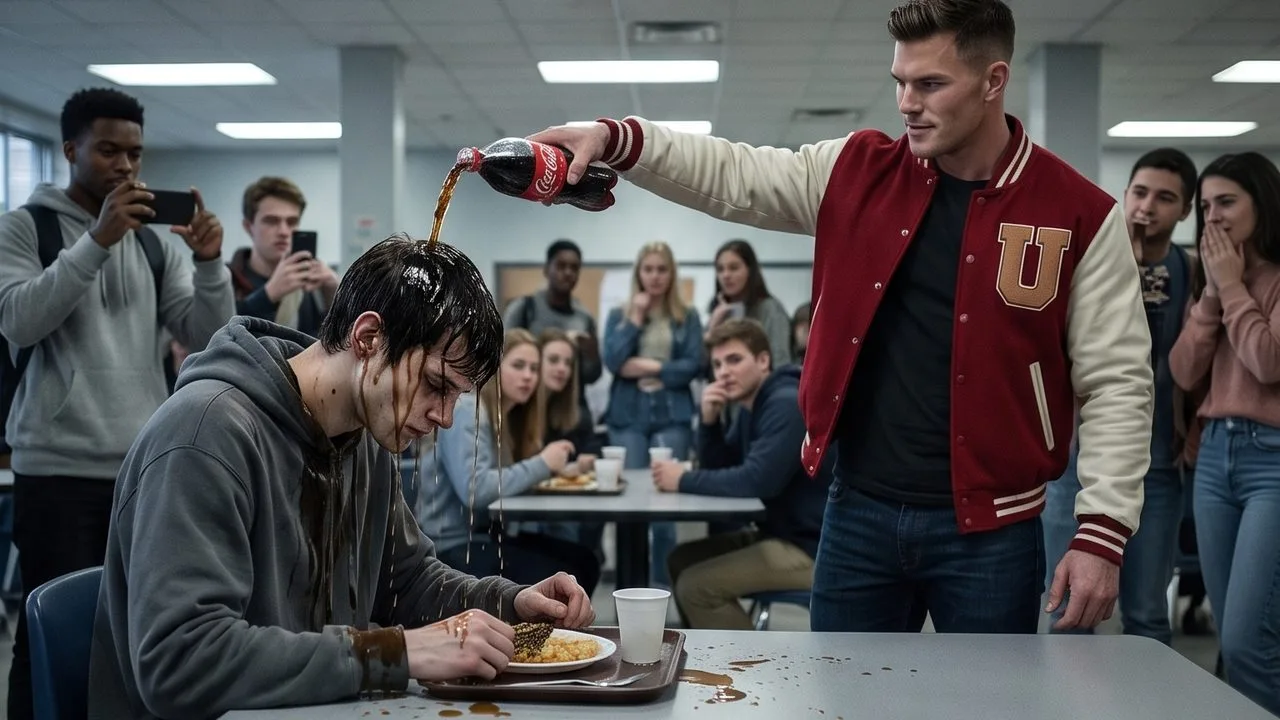
And the cafeteria — huge, noisy, alive — suddenly went quiet.
Not all at once. In a wave. First the nearby tables fell silent, then the far ones, and now a hundred faces had turned toward their corner, and in the silence that followed all you could hear was the steady drip of drops on plastic.
Simon sat motionless.
He didn't jump up, didn't shout, didn't wipe himself off. An old instinct, worked into his very bones, held him in place: freeze, wait it out, become smaller — and the storm will pass. He sat with his head down, and the cola ran off him onto the floor, and every second of that silence stretched into a small eternity.
Jacob lingered over him. And for one short moment — Simon didn't see it — he suddenly felt almost ill at ease. Looking down at how submissively, how hopelessly this guy accepted this too, without lifting his head, Jacob felt an unpleasant, out-of-place sting he found no name for and didn't care to look for. But the room was watching. The room was waiting for the finale. And Jacob pressed it home.
He carelessly dropped a paper napkin onto Simon's wet crown.
— Oops. Sorry. — His voice oozed false contrition. — My bad.
And the cafeteria exploded with laughter.
All these years Jacob had tormented him in earnest — harshly, inventively, without mercy. He'd hit him so hard the bruises took weeks to fade; done things Simon couldn't recall without everything inside him clenching with horror. But in public Jacob allowed himself only the small stuff — a shove in the hallway, a jab tossed in passing. Everything truly terrible he saved for the minutes when they were alone: in dead-end corners, behind closed doors, where no one saw them except maybe Craig keeping watch. It was their secret, their separate world hidden from everyone. And there, alone with Jacob, Simon — to his own shame, his own horror — stopped resisting: he went still, gave in, surrendered to the other man's force, because in the dark that pain was at least only theirs, no one else's.
But now it was different. Turned into a laughingstock for the whole room, all at once, under a hundred strangers' eyes, under raised phones. And this — the publicness of it, the turning of his pain into shared, greedy entertainment — turned out to be more terrifying than any blow behind a closed door.
And that laughter — collective, sated, jeering, rolling at him from every side — turned out to be too much. Something flared white and deafening in Simon's head, then went out. The pain was such that he stopped hearing, stopped thinking, stopped owning himself — as if he'd been yanked out of his own body and left with one solid, howling ring in its place.
The chair toppled backward with a crash. His hands seized the tray on their own and hurled it away — food, cola, plastic flew to the side, splattering across the floor. For one insane moment outside of reality, Simon stood in the middle of the buzzing crowd — soaked, shaking, his face streaked with cola and tears — and then his legs carried him on their own toward the exit, through strangers' shoulders, under the whistling and laughter flying at his back. He didn't even remember, afterward, how he'd run out.
The men's room was empty and echoing.
Simon stumbled in, and the heavy door slammed behind him, cutting off the laughter, leaving only the ringing in his ears and his own ragged breathing. He lunged for the sink, cranked the tap all the way open, and started frantically washing the cola off himself — out of his hair, off his face, off his neck. Icy water ran down him mixed with the sticky sweetness, but it couldn't wash off the humiliation. That had eaten in far deeper than skin.
He straightened. And lifted his eyes to the mirror.
His own reflection looked back at him from there. A face pale to the point of blue, wet matted hair, eyes red and swollen from crying. The defenseless, pitiful face of a man people had wiped their feet on for years — and who for years had silently allowed it. The face of a victim.
And at the sight of that face, disgust washed over him.
He hated it. Hated it desperately, to the point of nausea — that pale, smeared, tear-streaked face that had endured everything. The face of a doormat people had wiped their feet on for years while it only stayed silent and offered itself up for the next blow. The face of a freak who hates his tormentor — and, in that same sick head, invents filthy, shameful fantasies about him. In that second . Jacob at least didn't pretend. But this one, in the glass, was simply pathetic.
And for the first time in all these years Simon caught himself in a simple, calm thought that burned from the inside: he couldn't do this anymore. Didn't want to. An exhaustion came over him too vast to fit inside his body — exhaustion with himself, with every next morning, with the very fact that he had to wake up and be this thing in the mirror all over again. And somewhere beneath the hatred and the shame, at the very bottom, a black funnel quietly began to open — one that no longer held any anger or any pain, only an enormous, even, dead wish for all of it to simply end. For there to be nothing at all.
With a hoarse, inhuman cry coming from somewhere in his very gut, Simon drove his fist into the glass.
The mirror burst. Cracks sprayed out in every direction in a web, shards rained ringing into the sink, and the reflection split into a dozen crooked, mismatched pieces. His knuckles seared with pain, a thin trickle of blood ran down the back of his hand — but Simon barely noticed. He stood, breathing hard, and watched his own shattered face look back at him from a dozen shards at once.
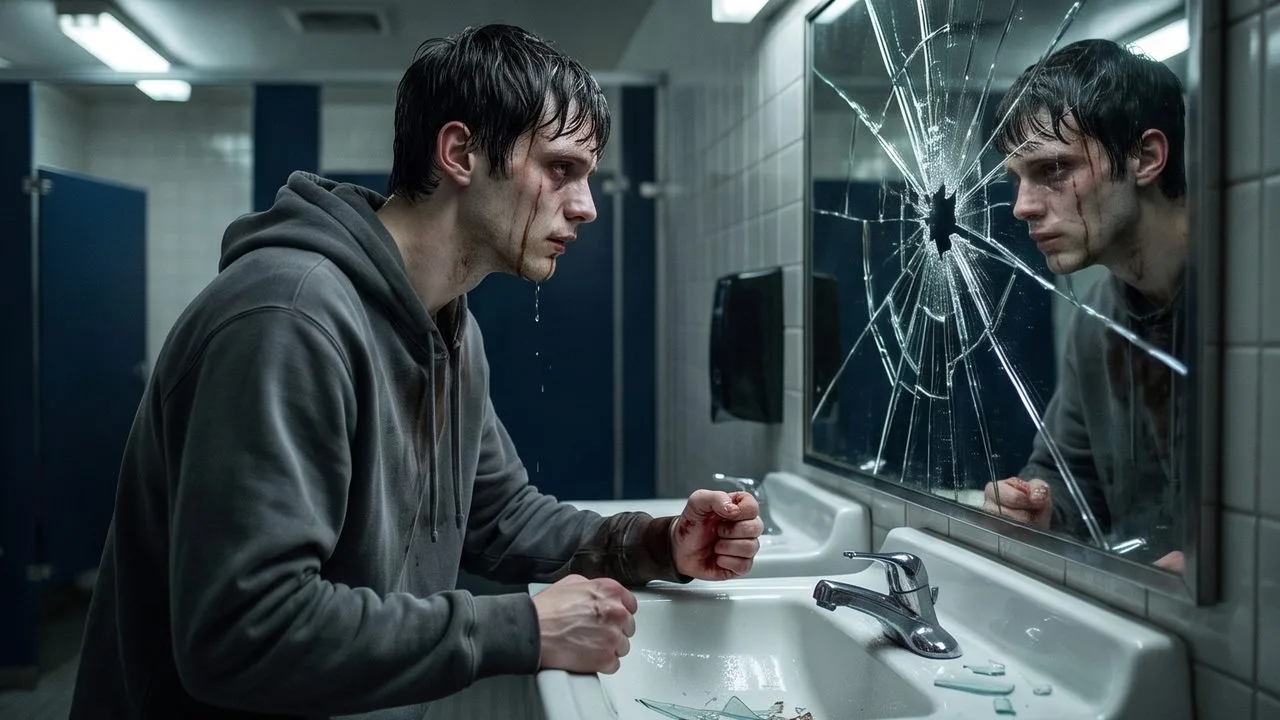
He hadn't become stronger, or braver. He'd simply cracked — quietly, finally, without any drama — the way something breaks when it's been bent too long in one direction.
— I'll make you pay, Jacob, — he breathed into the ringing silence. His voice came out quiet, foreign, terribly even. — For everything. You'll be sorry you ever touched me.
He didn't fully understand, himself, what he meant by it. He had no plan, no strength, not even any clear anger — only this dead evenness in place of his usual despair, the evenness of a man in whom everything had failed at once, burned out and gone quiet. He didn't yet know what exactly had broken in him. Didn't know where it would lead.
He knew only that the old Simon — the one who silently endured, hid in his music, and held out hope to the last — was gone. He'd stayed behind, lying in shards at the bottom of the sink. And there'd be no putting him back together.
The screen goes dark.
Continued in the next episode.