There is .
Simon had studied it for three years — not from textbooks, but with his body, his skin, that part of his brain that never shuts off even in sleep. He knew exactly which second to push the heavy door open to merge into the general flow and dissolve in it without a trace. He knew which side of the hallway to walk on so that someone else's back would always stand between him and the center. He knew not to raise his eyes, not to slow his step, not to take up even a gram more space than was allotted to someone like him.
He pressed the notebook to his chest with both hands — and not at all because of the cold. It was a shield. Paper armor against a world that long ago, back in his first year, had rendered its verdict without trial and without words.
And the roots of that verdict ran far deeper — long before university. Back home, where his father, having drunk to the bottom of a bottle, left behind more than just bruises. There, still a child, Simon had learned the main rule of survival: the less visible you are, the less they hit you. That stillness is also a way to survive. That if you freeze in time, shrink, become a shadow on the wall, furniture, an empty space — the storm sometimes passes without touching you. His body had learned this before his tongue learned words: don't resist, don't shine, endure. Let someone in — and it only gets worse. This is what home had taught him. And the choice of whether to let people in — no one had ever given him that.
And there was that one time in his first year when he broke his own rule. When he saw Jacob — loud, golden, indecently alive — and some naive, not-yet-beaten part of him reached out. He approached first. On his own. He spoke, asked something stupid about lectures — it didn't matter what, just to hook onto something, just to exist for a second in someone's eyes. He still hadn't forgiven himself for it. Because that was the second everything began. And now he knew firmly, knew it in his bones: reaching out to people was a luxury he was not entitled to.
The morning light in the university hallways was flat, white, merciless — it poured from long lamps overhead and left no shadows to hide in. The glass doors at the far end were flooded with the dim glow of a cloudy day. It smelled of dust, paper, someone else's perfume, and that particular scent of linoleum and metal that this place always carried. Hundreds of sneakers squeaked across the floor, hundreds of voices merged into an even hum, and in that hum Simon knew how to move like a fish in murky water — no one, nothing, a transparent point between other people's lives.
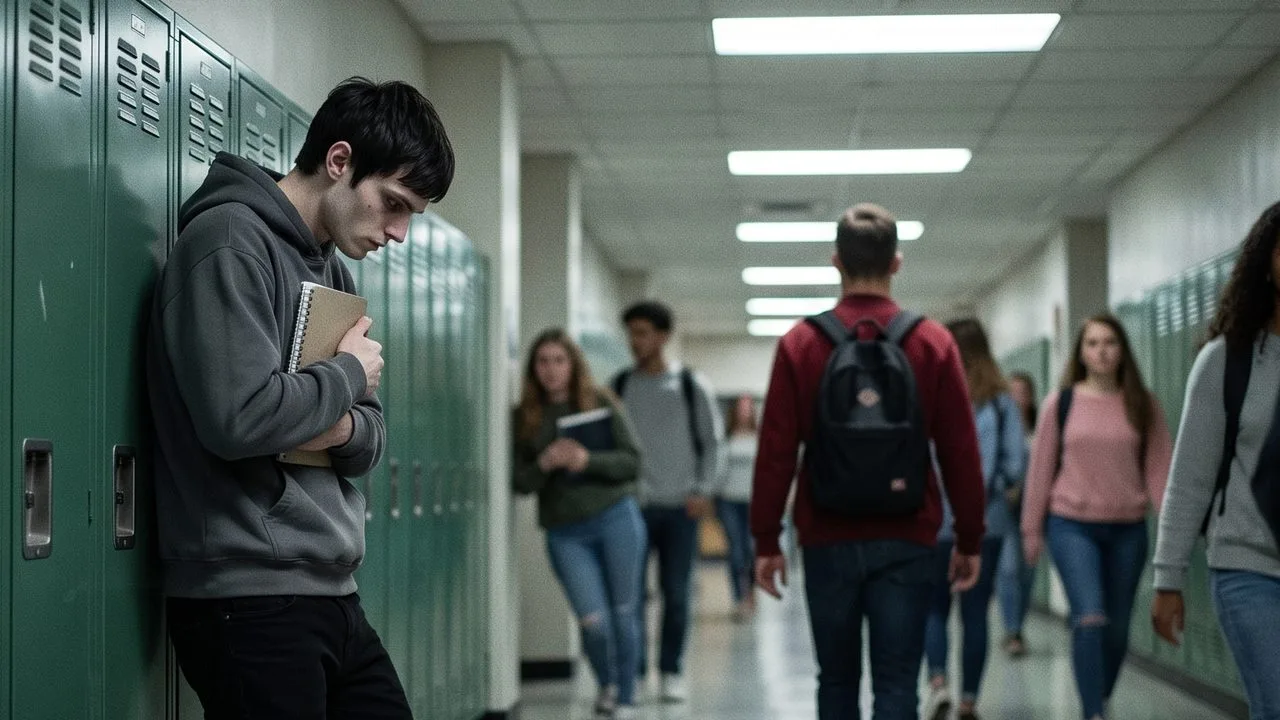
And yet every morning the same thing gave him away. His body knew before his mind did.
Nothing had happened yet — the flow hadn't faltered, the voices hadn't quieted — but under Simon's ribs a thin string had already pulled taut. He felt it as unerringly as an animal feels a storm beyond the horizon: somewhere at the other end of the hallway, Jacob had appeared.
Simon hated this sensitivity in himself. Hated how instantly everything inside him gathered, sharpened, began to listen. It was more humiliating than any blow — the fact that his own body kept a separate, always-open channel for this person. As if three years of fear had carved an invisible brand into him, and now it ached whenever its owner drew near.
He didn't turn around. He simply pressed the notebook to his chest a little harder and walked forward, counting the steps to the corner where he would finally be able to breathe.
Jacob entered the hallway the way kings enter throne rooms.
He didn't need to do anything for this. He didn't raise his voice, didn't push through the crowd — the crowd parted for him on its own, slightly, almost imperceptibly, by some ancient law that no one had ever written down but everyone knew by heart. The red-and-white university jacket with its proud letter "U" sat on his broad shoulders like a mantle. The hum of voices around him didn't quiet — but changed in tone: a watchfulness entered it. Someone straightened up, someone caught his eye hoping for a nod, someone looked away. The air around Jacob was always slightly charged — the way it is near someone who has the power to harm or to spare.
Beside him, step for step, walked Priscilla.
She was his match — striking, smooth, polished to a shine. Dark hair lay in a heavy wave, her red top echoed the color of his jacket, as if they had agreed beforehand, as if they were not two people but . She walked and smiled — not at the people, but at the very fact of walking here, beside him, at the top.
— Did you finish the economics homework? — she asked without slowing her pace.
— Almost, — Jacob replied. His voice was lazy, warm, assured — the voice of someone who had never in their life needed to hurry. — You?
— Almost too. — Priscilla snorted. — I'll copy from someone before class.
Jacob smiled from the corner of his mouth. Everything was familiar, smooth, rehearsed to automatism — this hallway, this girl, this morning in which everything belonged to him. He could have walked it with his eyes closed. And that was exactly why he felt so… empty.
He didn't think about this in words, of course. Kings don't complain. But somewhere at the very bottom, beneath the armor of other people's admiration, he always carried a hunger — steady, dull, unnamed. He needed something to resist — something to sharpen his teeth on, something to feel alive against.
And then his gaze, which had been drifting over the crowd with its habitual royal indifference, caught against something involuntarily — and wouldn't let go.
A gray hoodie. A slight figure pressed against the wall of lockers. A notebook clutched to the chest with both hands, as if its owner feared it would be taken away. A pale face, downcast eyes, dark circles from chronic sleeplessness.
— Oh, — Jacob said, and the lazy smoothness left his voice for a moment. — Simon's here.
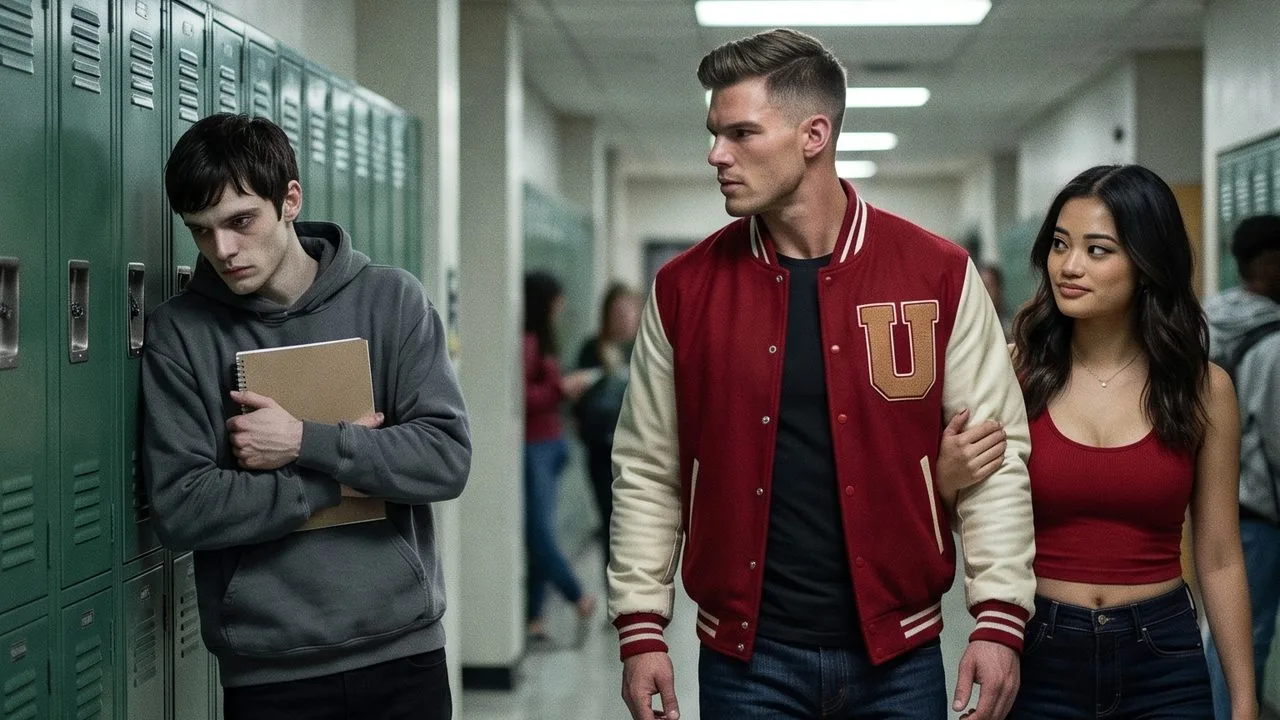
He didn't notice himself slow down. Didn't notice his head turn on its own — as if pulled. He didn't register that a moment before, there had been grey emptiness in his chest, and now something warm was spreading through it — angry, alive, and all the more shameful for being almost pleasant. If asked, he would have called it irritation. And he would have sworn he wasn't lying.
Among the dozens of faceless people, among all that grey mass he neither distinguished nor remembered, there was one — this quiet, beaten-down guy who somehow refused to blend into the background. Who got stuck. Who had somehow lived under his skin for three years, like a splinter you can't be bothered to pull out: its dull, aching pain had long since become familiar — almost his own.
And yet — if someone had asked sincerely, if Jacob had allowed himself even a second of honesty — he couldn't have explained a simple thing. Why his feet had been carrying him into this particular hallway for the third day running. His classroom was in the other wing, on the completely opposite side. His crew didn't care where they wandered before class. But he kept leading them here — past these green lockers, past this wall — and he didn't admit to himself that it wasn't him choosing the route. That he, unbeknownst to himself, .
He would have said he wasn't chasing anyone. That kings don't chase prey — they wait, and the world brings them what is rightfully theirs. He would have believed it himself. Except that his gaze found Simon in any crowd by itself, without instruction, in a fraction of a second — the way you pick out from a hundred unfamiliar faces not a stranger, but the one you are always searching for. Even when you swear you've forgotten them.
That question didn't even try to rise to the surface — and if it had, Jacob would have drowned it without looking.
But Priscilla noticed.
She always noticed things like this — it was her gift and her curse. She could read faces, pauses, the direction of glances; she could calculate someone else's interest before the person was even aware of it themselves. That was how she had once calculated and won Jacob himself. That was how she now felt a prick — thin, cold, right at her heart — when she saw where her boyfriend was looking.
She followed his gaze. A gray hoodie. A pale boy by the lockers.
— You're staring at him so hard, — she said. The tone was light, teasing, but underneath it, at the very bottom, something rang thinly — like ice settling to the bottom of a glass. — Do you even know how much attention you give him?
Jacob blinked, as if pulled from something.
— Who? — he asked too quickly. And immediately looked away — too quickly. — Oh, him. — The smile came out crooked, fake. — He just gets on my nerves.
— Uh-huh, — said Priscilla.
— Freak, — Jacob added, as if that explained everything. — Loser. Nothing to look at.
He said it easily, contemptuously, the way you speak of something not worth a second thought. But Priscilla knew her king. She saw him tense — for a fraction of a second, almost imperceptibly. She saw that he'd spat out the word "freak" a little too fast, a little too loud — .
She said nothing more. She only smiled — that smile that never quite reaches the eyes — and took his arm a little tighter than a minute ago. A small, possessive movement. As if marking a boundary. As if placing a mark on something — on someone: mine.
She didn't yet know who she was fighting against. But her instinct — the one that always sensed danger first — had already taken its stance.
Simon looked up for one second. Exactly one.
And immediately regretted it.
Through the heads, through the hum, through all the distance between them, he met Jacob's eyes — and for a brief, nauseating moment the world narrowed to that single gaze. The king's dark eyes looked at him with that lazy, predatory interest with which a cat watches a mouse cornered — knowing in advance it will catch it, and savoring that knowledge in advance.
"Here we go. Him again."
Everything inside Simon sank into a cold lump. Exhaustion — that was what he felt first. Not even fear, but the dull, hopeless exhaustion of someone who knows all too well what comes next. Now Jacob would come over. Now he would say something — quietly, almost tenderly, in that insinuating voice that made you want to press yourself into the wall and sink through the floor at the same time. Now it would all begin again, the same circle it had been going in for three years.
Simon looked down and began to count frantically. Eight steps to the corner. If he sped up — he could make it. If he made it — maybe he'd be spared. Just don't look. Just don't slow down. Just be transparent, flat, nothing…
But beneath the exhaustion, beneath the fear — in the part of himself he hated most — something entirely different responded to that look. There, where three years had carved that invisible channel — for Jacob alone — something pulled hotly, and a shiver ran across his skin: shameful, sweet, the kind that makes you want to squeeze your eyes shut.
His body received someone else's hatred as if it were a caress.
Because Jacob was looking at him. At him. Out of everyone in this hallway — at him. And some broken, starved part of Simon, the part that for years had gone unnoticed, uncalled by name, passed over with a glance as if it were an empty space — that part . Even if it was hatred. Even if it was contempt. Even if it was a hunt. But it was directed at him — which meant that in someone else's world, he still existed.
"I hate him," Simon told himself, and the words rang in his head evenly, by rote, like a prayer no one has believed in for a long time. "I hate him."
So why was his heart pounding as if he were not running away, but running toward?
Jacob pulled away from Priscilla.
He did it automatically — freed his elbow from her fingers without even noticing she'd been holding it tighter than usual. He was pulled forward — and he walked toward it the way you walk toward light in darkness, without asking where it comes from. His crew stayed behind. The hum of the hallway receded, turned into background noise. What remained was only a narrow tunnel of air between him and the slight gray figure by the lockers.
Simon quickened his step. Too late.
The red-and-white jacket bore down — wide, blocking the light. Simon felt its approach with his back, the nape of his neck; felt the world narrowing, the hallway collapsing into these final meters where there was nowhere left to hide. Eight steps. Six. Four. The palms beneath the notebook went damp, his throat dried out — and the treacherous drumming in his chest was louder than fear.
He didn't make it to the corner.
A shadow grew above him, very close. Warm, heavy, smelling of someone else's deodorant and the leather of a jacket. Simon raised his eyes — slowly, with the resignation of someone raising them to something that cannot be stopped.
And met Jacob's gaze. Two steps away. One.
The king of campus looked down at him, and on his handsome face there slowly, inexorably bloomed that particular smile — lazy, predatory, anticipating. The smile of someone who has finally found something to sharpen his teeth on during this grey, empty morning.
— Hey, — Jacob said. Quietly. Almost tenderly.
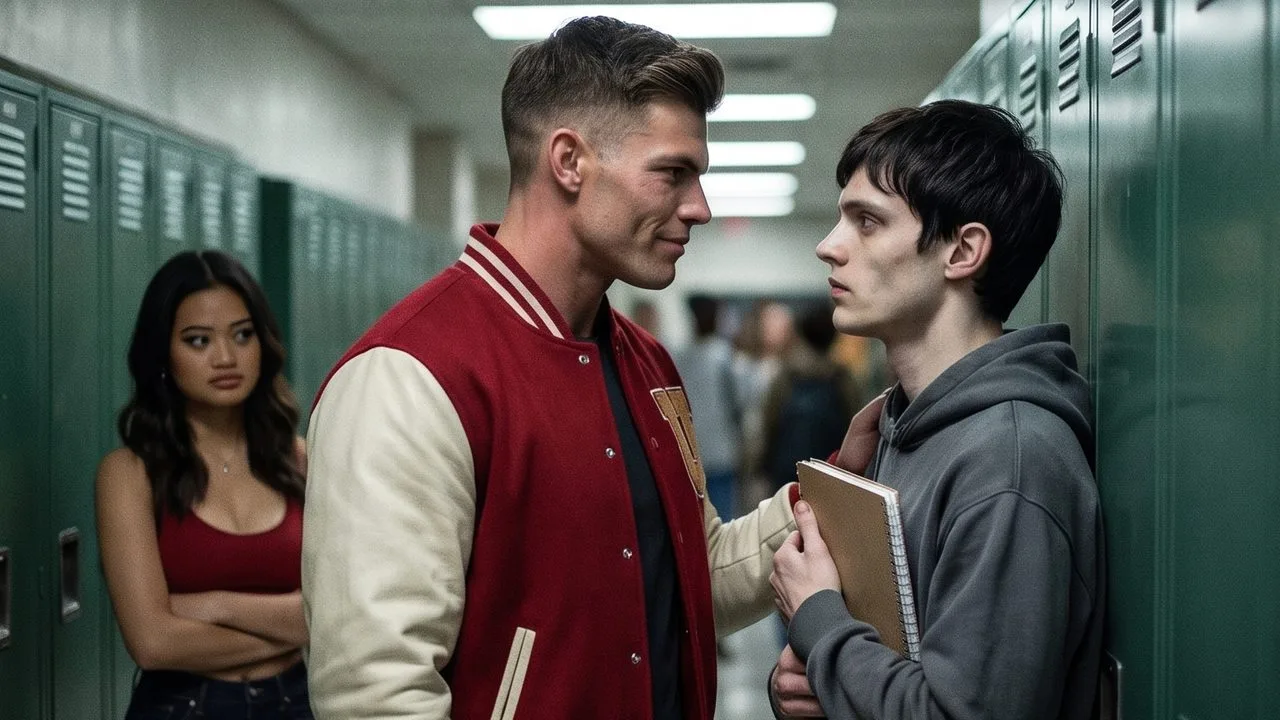
The hallway around them went on living — humming, laughing, rushing to lectures, unaware that beside the wall of green lockers, in this tiny point in space, the first loop had just closed.
Neither of them knew yet.
That this second was a beginning.
That from it, like a black thorn growing from under the skin, everything else would slowly emerge: hatred that would turn into obsession, love that would turn into poison, and the price that both would pay.
The king leaned toward his prey.
The screen fades.
To be continued in the next episode.